
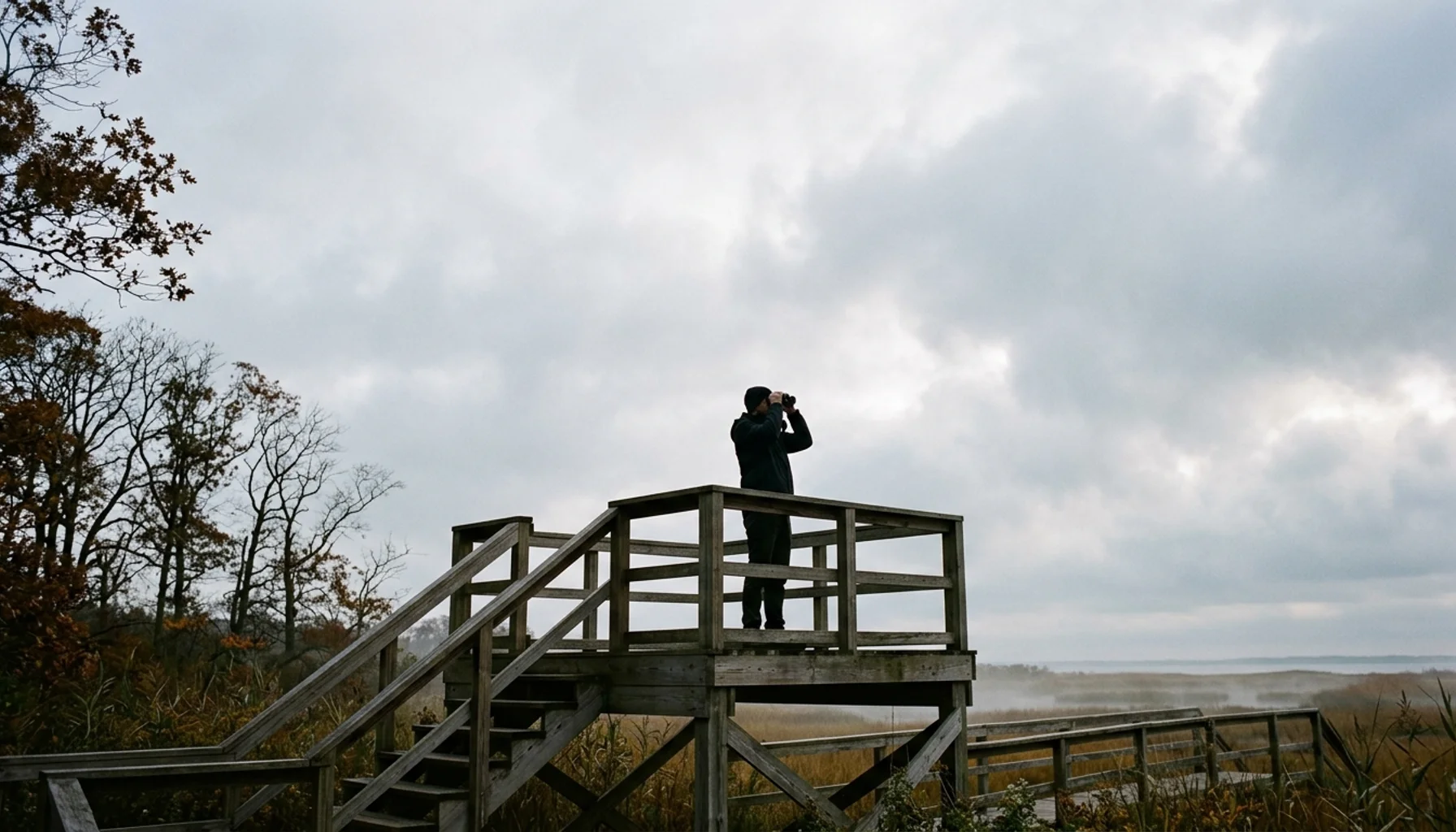
Bird watching in Cape May, NJ refers to the practice of observing migratory and resident bird species at one of North America’s most celebrated birding destinations, a narrow peninsula at the southern tip of New Jersey where the Atlantic Ocean meets Delaware Bay and funnels hundreds of millions of birds into a concentrated geographic bottleneck each spring and fall. Cape May’s position on the Atlantic Flyway, combined with its extraordinary habitat diversity spanning salt marsh, freshwater wetland, coastal scrub, open farmland, and beachfront, makes it unlike any other birding site on the East Coast.
- Prime fall migration runs September 1 through approximately December 10, with the Hawkwatch platform at Cape May Point State Park counting between 30,000 and 45,000 raptors per season.
- Spring migration peaks in May, when warblers, shorebirds, and thrushes arrive from South America; Delaware Bay beaches simultaneously host one of the eastern seaboard’s most dramatic wildlife spectacles involving Red Knots and horseshoe crabs.
- Cape May conducted one of the first Christmas Bird Counts in 1901, establishing it as one of America’s oldest organized birding destinations.
- South Cape May Meadows, owned by The Nature Conservancy, covers 200 acres with an ADA-compliant boardwalk and more than two miles of flat, walkable trails free of charge.
- Beginner birders should download the free Merlin Bird ID App by Cornell Lab before arriving; experienced listers should set up eBird hotspot alerts for Cape May Point at least a week before their visit.
- Cape del Mar’s properties in Cape May’s historic district sit within walking distance or a short drive of every major birding hotspot in this guide.
Cape May has been drawing serious birders for well over a century, and in 2026 the destination shows no signs of losing its reputation. According to Cape May County Government data, the county welcomed 12.1 million visitors in 2026 and generated $8.1 billion in direct tourism spending. A significant portion of those visitors arrive specifically for the birding. National Geographic has named Cape May among the world’s top 10 bird-watching destinations, and approximately 100 serious birders now live in the area year-round, up from just a couple when renowned author Richard Crossley relocated there in January 1991.
Whether you are visiting for a single morning or building a week-long itinerary around target species, this guide covers every major hotspot, the best timing by month and skill level, practical logistics most visitors never figure out, and the tools that will transform a good birding trip into an exceptional one. At Cape del Mar, we manage a collection of renovated vacation rentals in Cape May’s historic district, and the proximity of our properties to these sites is something guests mention repeatedly. That local position shapes every recommendation below.
What Is the Best Birding Month in Cape May, NJ?
The best single month for bird watching in Cape May, NJ is October, when peak raptor migration, songbird fallouts, and shorebird concentrations overlap in a way that no other month matches. September through November represents the core fall window, but mid-October routinely produces the highest species diversity and the largest single-day counts. On one documented late-October morning at Cape May Point, counters tallied over one million birds in the first hour of light, a total dominated by American Robins, Yellow-rumped Warblers, Common Grackles, and Red-winged Blackbirds moving en masse.
That said, the right month for your trip depends on what you want to see. Here is a practical breakdown by season:
| Season | Timing | Highlight Species | Best Sites |
|---|---|---|---|
| Spring Migration | Late April to late May | Warblers, vireos, thrushes, shorebirds | Higbee Beach, South Cape May Meadows, Delaware Bay beaches |
| Summer | June to August | Nesting Black Skimmers, terns, herons | Cape May City beach (between Convention Hall and 2nd Ave), Stone Harbor Point |
| Fall Migration | September 1 to December 10 | Raptors, warblers, sparrows, waterfowl | Cape May Point State Park Hawkwatch, Higbee Beach, Coral Avenue platform |
| Winter | December to February | Waterfowl, sea ducks, winter sparrows | Lake Lily, Cape May Bird Observatory gardens, Sunset Beach |
Fall migration at Cape May effectively runs from July 1 until Christmas, nearly half the year. The Hawkwatch platform at Cape May Point State Park is staffed by counters and naturalists all day from September 1 to approximately December 10. For visitors arriving in mid-September, Broad-winged Hawks dominate the counts. By late September and October, Sharp-shinned Hawks, Cooper’s Hawks, Merlins, and Peregrine Falcons take over. November brings Golden Eagles and rare buteos to the platform.
Spring gets less attention but rivals fall for pure spectacle. The Cape May Spring Festival, organized by New Jersey Audubon, draws world-class leaders and authors for guided walks and presentations each May. In 2026, plan that visit for the second or third week of May for peak warbler diversity. The Naturalist Journeys Cape May Spring Migration Tour for May 12 to 18, 2026, was listed as full, which itself signals how serious the demand is for that specific window.

Where Are the Best Birding Spots in Cape May?
The best birding spots in Cape May, NJ are concentrated at the southern tip of the peninsula and fall into four main categories: coastal hawk watching platforms, freshwater and salt marsh preserves, woodland scrub habitat for songbird fallouts, and Delaware Bay beaches for shorebird staging. Each site attracts different species and rewards visitors at different times of day and year. Knowing which habitat to prioritize for your target species saves hours of unproductive searching.
Cape May Point State Park: The Hawkwatch Platform
Cape May Point State Park is the anchor of any serious Cape May birding itinerary. The park’s Hawkwatch platform, situated near the Cape May Lighthouse, is staffed by counters from September 1 through early December and provides a front-row seat to one of North America’s most reliable raptor spectacles. Between 30,000 and 45,000 raptors pass over per season, with peak counts during northwest winds following cold fronts in October. Arrive early. Platform spots fill by 7 a.m. on good migration mornings.
Beyond raptors, the park’s freshwater ponds and surrounding scrub hold a rotating cast of migrant warblers, vireos, and sparrows throughout fall. The platform at the end of Coral Avenue at Cape May Point, just outside the park boundary, has become a popular spring and fall morning watch spot for ducks, loons, and seabirds passing low over the ocean. Visit the Official Cape May Point State Park page for current trail maps and seasonal closures before you go. Parking in the main lot is free, though the lot fills quickly on October weekends.
South Cape May Meadows: The Best Walk for Mixed Species
South Cape May Meadows, a 200-acre preserve owned and managed by The Nature Conservancy in New Jersey, sits at a critical pinch point on the Atlantic Flyway and borders the beach where the old town of South Cape May once stood before being washed away by the sea. The preserve features more than two miles of flat, walkable trails and a full mile of undeveloped, protected beach, making it the most accessible major birding site in the area.
An ADA-compliant boardwalk with handrails, benches, and braille signage runs through the wetland core. A welcome center at the entrance includes an interactive kiosk with bird calls, preserve ecology information, and an interactive trail map. Visit at dawn for the best songbird activity. In fall, the meadows regularly hold Marsh Wrens, Common Yellowthroats, and large sparrow flocks. The freshwater impoundments attract ducks, rails, and occasional shorebirds when water levels are right.
Higbee Beach WMA: The Songbird Fallout Site
Higbee Beach Wildlife Management Area is state-managed land at the northwest corner of the peninsula, and it is often the first stop for exhausted migrating songbirds arriving across Delaware Bay after an overnight flight. The site features dunes, forest, scrub-shrub, and open fields. On mornings after northwest winds, the trees at Higbee can be dripping with warblers, a phenomenon birders call a “fallout.” Show up before sunrise and walk quietly through the wooded sections first.
The open fields at Higbee also serve as a secondary hawk watching location, and in late September the scrubby edges hold American Kestrels perched on fence posts. Note that dog access at Higbee Beach WMA follows New Jersey state regulations for Wildlife Management Areas. The NJ Department of Fish and Wildlife Wildlife Management Area Regulations page has current access rules. Arrive with a flashlight for pre-dawn access along the gravel paths.
Cape May Bird Observatory: Your Information Hub
The Cape May Bird Observatory (CMBO) is located on East Lake Drive at the north end of Lake Lily in Cape May Point and serves as the primary on-the-ground authority for Cape May birding. The observatory is open year-round with seasonally varying hours, sells books, optics, and field guides, and maintains bird feeders and a water feature in its gardens that attract species throughout the year. Stop here first on any visit to check the whiteboard for recent sightings and pick up a current hotspot map.
CMBO staff and volunteers also lead guided walks throughout the year. These walks are among the fastest ways for beginners to find species they would otherwise miss. Check the Cape May Bird Observatory Blog, View from the Cape, for real-time sighting reports and trip reports before you arrive. This blog is genuinely the best single resource for knowing what is being seen at Cape May in any given week of 2026.

Are There Birds in Cape May in May? The Spring Migration Story
Yes, May is one of Cape May, NJ’s two peak birding months, and for warbler diversity and shorebird spectacle it arguably rivals fall. Spring migration at Cape May concentrates dozens of warbler species, thrushes, vireos, and shorebirds moving north from their South American wintering grounds. The first two weeks of May represent peak warbler activity, while the second and third weeks bring the Delaware Bay shorebird staging to its climax.
The Delaware Bay beach spectacle is one of the most extraordinary wildlife events in North America and deserves specific mention. Red Knots, Semipalmated Sandpipers, and Ruddy Turnstones arrive on Delaware Bay beaches including Cooks Beach and Norbury’s Landing to feast on horseshoe crab eggs. These birds must double their body weight in just days before completing their migration to Arctic breeding grounds. The volume of birds at these beaches in mid-May can be staggering.
For spring birding, prioritize these sites in order:
- Higbee Beach WMA for warbler fallouts, especially in the woods after northwesterly nights
- Cooks Beach and Norbury’s Landing on Delaware Bay for the horseshoe crab and shorebird spectacle in mid-May
- South Cape May Meadows for mixed migrant warblers, sparrows, and marsh birds around the impoundments
- Beach Plum Farm in West Cape May for views over Pond Creek Marsh plus the option of breakfast sandwiches and coffee at Beach Plum Farm Cape May
- Belleplain State Forest for spring specialties including Hooded, Yellow-throated, and Prothonotary Warblers, Summer Tanager, and Acadian Flycatcher; the New Jersey Audubon trail guide for Belleplain is the most useful resource for planning that day trip
The Nature Center of Cape May, operated by New Jersey Audubon, also runs spring programs, guided salt marsh kayak tours, and shorebird presentations in May. Check their schedule early in the year because popular programs sell out weeks in advance.
One honest caveat for May visitors: Cape May gets genuinely crowded during peak spring weekends, particularly when the Cape May Spring Festival coincides with good migration weather. Accommodation books fast. If you are planning a May birding trip in 2026, securing lodging 8 to 12 weeks in advance is not an overstatement of urgency.
What Are the 5 S’s of Bird Watching?
The 5 S’s of bird watching are a beginner framework for identifying and confirming bird species in the field: Size, Shape, Seasonality, Surroundings, and Sounds. Experienced birders apply these criteria instinctively, but for first-time visitors to Cape May, understanding the framework turns a frustrating morning of unidentified brown birds into a genuinely rewarding experience. Cape May is one of the best places on Earth to practice this framework because the habitat variety forces you to apply all five criteria within a short walk.
- Size: Compare the bird to a known species. Sparrow-sized, robin-sized, crow-sized. At Cape May Point State Park’s Hawkwatch platform, naturalists routinely help visitors calibrate by comparing soaring raptors to Turkey Vultures, which are nearly always overhead as a size reference.
- Shape: Wing shape, tail shape, and bill shape are often diagnostic even at distance. Sharp-shinned Hawks have squared tails; Cooper’s Hawks have rounded ones. Practice at the Hawkwatch where raptors circle long enough to study.
- Seasonality: A warbler in October at Cape May is almost certainly a fall migrant. Knowing which species migrate through in which window narrows your identification choices dramatically. The CMBO’s seasonal guides, available at the observatory, list expected species by month.
- Surroundings: Habitat determines species. A sparrow in the salt marsh at South Cape May Meadows is probably a Saltmarsh or Seaside Sparrow. The same sparrow in the Higbee Beach fields is far more likely a Savannah or Song Sparrow.
- Sounds: Song and call notes are often faster than visual identification, especially in dense scrub. Download the free Merlin Bird ID App by Cornell Lab before you arrive. Merlin’s Sound ID feature will identify songs and calls in real time by listening through your phone’s microphone. It works remarkably well in Cape May’s open habitats.
For citizen science, pair Merlin with eBird Mobile to log and share your sightings from each Cape May hotspot. Your submitted checklists contribute directly to the scientific database used by ornithologists tracking population trends for species like the Red Knot, which faces ongoing conservation pressure linked to declining horseshoe crab populations on Delaware Bay.
Birding by Boat, Marsh, and Beyond: Underrated Cape May Experiences
Salt marsh birding by boat is one of Cape May’s most underrated birding experiences, and it requires no previous birding expertise to enjoy. The Osprey pontoon boat departs from Miss Chris Marina for salt marsh birding tours along New Jersey’s Intracoastal Waterway, offering close approaches to nesting herons, egrets, and Ospreys that would be impossible to achieve on foot. These tours run seasonally and tend to fill on weekends.
For an entirely different perspective, consider a pelagic or bay-crossing birding experience. The ocean “rips” at Cape May Point is an offshore upwelling caused by the meeting of Atlantic Ocean and Delaware Bay currents. This convergence creates feeding frenzies of gulls and Northern Gannets that can attract rare oceanic species including jaegers and shearwaters during migration. A pair of binoculars and a position on the Sunset Beach jetty on a breezy October morning can produce spectacular seabird activity without any boat trip required.
The Cape May Whale Watch and Research Center, which has operated as an eco-tour since 1987, also offers birding-adjacent experiences on Delaware Bay. Their naturalist-led tours often produce strong seabird lists alongside the cetaceans. Nummy Island, accessible by causeway from the Stone Harbor area, is worth a dedicated morning for its nesting Black-crowned Night-Herons and nearby sparrow habitat supporting Nelson’s, Saltmarsh, and Seaside Sparrows. Stone Harbor Point adds Common, Forster’s, Caspian, and Royal Terns plus shorebirds and waterfowl to any itinerary focused on coastal species.
Rhea’s Farm on Bayshore Road in West Cape May, locally known as “The Beanery” because of old lima bean harvesting machines from the 1970s and 1980s, is the kind of place no tourist guide mentions. It sits in what birders describe as the warmest part of the peninsula, making it a reliable hawk watch location in light northwest winds when other spots underperform. The open fields and edges attract American Kestrels, Merlins, and sparrows through October. There is no formal trail or fee, just a gravel pull-off and patience.
The broader Cape May area also includes day-trip options worth building into a multi-day itinerary. The Bayshore Center at Bivalve, home to the schooner A.J. Meerwald, sits on Delaware Bay and offers a completely different angle on the shorebird staging habitat. The Edwin B. Forsythe National Wildlife Refuge covers 43,000 acres of fresh and salt water marsh north of Atlantic City, roughly 90 minutes from Cape May, and appears on most serious birders’ itineraries as a full-day excursion for waterfowl and raptors in fall.

Winter Birding in Cape May: The Overlooked Season
Winter birding in Cape May, NJ refers to the observation of overwintering waterfowl, sea ducks, winter sparrows, and occasional rare species that congregate in the area from December through February, a season that almost no competitor guide bothers to cover. This neglect makes winter Cape May one of the easiest ways to have a quality birding experience without competing for platform space or parking spots with thousands of other visitors.
Lake Lily, immediately adjacent to the Cape May Bird Observatory on East Lake Drive, is the winter centerpiece. During cold snaps, concentrations of Ring-necked Ducks, Lesser Scaup, Buffleheads, and Hooded Mergansers pack the lake. In freeze years, the ducks move to tidal creeks and open bay sections, sometimes producing unexpected rarities. The CMBO’s garden feeders stay active through winter and regularly attract Fox Sparrows, White-throated Sparrows, and Carolina Wrens.
Cape May also holds its Christmas Bird Count, one of the oldest in North America, dating to 1901. This annual count gives winter birding in Cape May legitimate scientific gravity. Participating in or following the count results gives visiting birders a meaningful data set for targeting species in their own December visits. Contact the Cape May Bird Observatory for information on joining the 2026 count as a volunteer counter.
The beach section between Convention Hall and 2nd Avenue on Cape May City’s shoreline holds a large flock of Black Skimmers in late fall, often persisting into early December. Sunset Beach in Cape May Point is a productive winter seabird vantage point for Long-tailed Ducks, Common Loons, and Red-throated Loons moving along the bay mouth. Dress for wind. November and December mornings on Delaware Bay can feel significantly colder than the official temperature due to persistent onshore breezes.
Practical Tools and Apps for Bird Watching in Cape May in 2026
Technology has changed Cape May birding meaningfully since the pre-smartphone era, and visitors who arrive prepared with the right digital tools consistently see more species than those who do not. The following tools are specifically useful for Cape May visitors in 2026, not just generic birding recommendations.
Merlin Bird ID App
Download the Merlin Bird ID App by Cornell Lab before you arrive and download the Eastern North America bird pack for offline use. Cape May’s cellular coverage is generally good, but the preserve interiors and beach areas can drop signal. Merlin’s Sound ID feature is particularly valuable at Higbee Beach and South Cape May Meadows, where dense scrub makes visual identification difficult. The app is free.
eBird Hotspot Alerts
Set up eBird hotspot alerts for Cape May Point State Park, Higbee Beach WMA, and South Cape May Meadows at least a week before your visit. These alerts notify you by email when other birders submit unusual or rare species sightings at those specific locations. If a Painted Bunting or a rare warbler shows up at Higbee in the 48 hours before you arrive, you will know exactly where to stand. Use eBird Mobile during your visit to log sightings and contribute to the citizen science database.
iNaturalist for Non-Bird Wildlife
Cape May’s preserves hold far more than birds. Monarch butterfly migration, diamondback terrapins, and unusual plant communities make the area a naturalist destination, not just a birding one. iNaturalist handles wildlife identification beyond birds and is worth having active when you walk the South Cape May Meadows boardwalk, where autumn brings large concentrations of migrating dragonflies and butterfly species alongside the bird movement.
CMBO Real-Time Sighting Reports
The single most useful pre-trip resource for Cape May birding in 2026 is the Cape May Bird Observatory Blog, View from the Cape. Updated regularly by observatory staff, this blog reports recent sightings, weather impacts on migration, and specific hotspot conditions. Check it the evening before each birding day to calibrate your morning plan.
Beginner vs. Expert Itineraries for Cape May Birding
Cape May birding itineraries differ fundamentally depending on experience level, and no competitor guide addresses this gap. A first-time birder spending one morning benefits from a completely different approach than an experienced lister building a target species checklist for a five-day fall visit. Both audiences will find Cape May rewarding, but only if they approach it correctly.
First-Time Birder: A Single Morning Plan
Start at the Cape May Bird Observatory on East Lake Drive to check the whiteboard for recent sightings and pick up a free site map. Spend the first hour walking the CMBO’s garden, where feeders attract sparrows, finches, and warblers at close range. Then walk or drive five minutes to Cape May Point State Park and position yourself at the Hawkwatch platform by 9 a.m. The platform naturalists will explain what they are counting and point out species by name as they pass. Finish with a 30-minute walk on the flat trail at South Cape May Meadows before the midday heat reduces activity. This itinerary requires no prior knowledge and produces 30 to 50 species on a typical fall morning.
Experienced Lister: A Three-Day Fall Itinerary
Day 1: Pre-dawn at Higbee Beach WMA for the morning songbird flight through the wood edges. Move to the Coral Avenue platform for seabirds and ducks over the ocean from 7 to 9 a.m. Spend mid-morning at the Hawkwatch. Afternoon at South Cape May Meadows for marsh birds and sparrows. Evening check of Lake Lily for roosting waterfowl.
Day 2: Full day trip north to the Edwin B. Forsythe National Wildlife Refuge for waterfowl, rails, and raptors over the impoundments. The 8-mile Wildlife Drive at Forsythe produces a fundamentally different species mix than Cape May’s peninsula sites, including large numbers of Black Ducks, Brant, and Northern Harriers. Return via Stone Harbor Point for terns and shorebirds.
Day 3: Morning hawk watch at Rhea’s Farm (The Beanery) in West Cape May for a less-visited perspective on the raptor flight. Mid-morning walk at the Garrett Family Preserve, covering 180 acres for mixed woodland and edge species. Afternoon at Nummy Island for Night-Herons and salt marsh sparrows. End the trip with sunset at Sunset Beach watching loons and sea ducks moving south over Delaware Bay.
Conservation Context: Why Cape May Birding Matters Beyond the List
The conservation story behind Cape May’s birding scene is more urgent than most visitors realize, and understanding it deepens the experience considerably. The Red Knot’s dependence on horseshoe crab eggs at Delaware Bay beaches represents one of the most documented examples of ecological interdependence in North American conservation biology. These shorebirds arrive from South America with fat reserves depleted by the journey. Without horseshoe crab eggs as a caloric source, they cannot complete the flight to Arctic breeding grounds. Declining horseshoe crab populations in previous decades caused documented drops in Red Knot populations, leading to the species’ listing as threatened under the Endangered Species Act.
Visitors can contribute to this conservation effort during their Cape May trip by submitting eBird checklists from every site they visit. The citizen science data collected through eBird directly informs population monitoring for species including the Red Knot, Semipalmated Sandpiper, and Piping Plover. Contact the New Jersey Audubon for information on volunteer opportunities with shorebird monitoring programs during spring migration, including beach surveys during the horseshoe crab spawning peak in mid-May.
Cape May’s conservation infrastructure is also unusually strong compared to other birding destinations. The Nature Conservancy manages South Cape May Meadows. New Jersey Audubon operates the Nature Center and CMBO. The state manages Higbee Beach WMA and Cape May Point State Park. This multi-agency framework means habitat protection is layered, which is a primary reason the birding quality at Cape May has remained high despite the region’s development pressure over the past three decades.
Where to Stay for Bird Watching in Cape May, NJ
Base location matters more for Cape May birding than most visitors anticipate. The top birding sites cluster at the southern tip of the peninsula, which means a property in Cape May’s historic district or Cape May Point itself puts you within 10 to 15 minutes of every major hotspot in this guide. Hotels in Wildwood or North Cape May add 20 to 30 minutes of drive time to morning sessions, and those early minutes matter when dawn is peak activity time.
For birders traveling as couples or solo, Cape Belvedere sits on the top floor of the historic Belvedere building in Cape May’s National Historic Landmark district, two minutes from Congress Hall and one block from the beach. The condo sleeps up to 6 adults and 2 children across two bedrooms, and the signature cupola with panoramic views and lounge chairs gives you a genuine elevated vantage point to scan the sky at dawn for passing raptors and seabirds before you even leave the property. On clear mornings, Delaware is visible on the horizon. The Cape May Bird Observatory on East Lake Drive is roughly a 10-minute drive from Cape Belvedere.
For families or small groups who want to be even closer to the beach, Cape Surf and Cape Whale are both located in the historic Baronet Mansion on Beach Avenue, directly across from the ocean in Cape May’s historic district. Both one-bedroom condos include complimentary beach tags, a fully stocked kitchen, and organic toiletries as a baseline standard. Cape Whale is pet-friendly, which matters if you are bringing a birding dog to the field.
Couples or friends groups needing a bit more space will find Cape Wave a strong fit. This two-bedroom, two-bathroom top-floor apartment in an 1860 Victorian house sits one block from the Washington Street Mall and is a five-minute walk to the beach. The rooftop deck is particularly useful for morning sky-watching before heading to the Hawkwatch. Cape Wave accommodates up to 4 guests and includes beach tags, linens, and cooking basics. You can read more about where to stay in Cape May by neighborhood to find the right fit for your group size and priorities.
For birders who want maximum walkability and easy access to the Washington Street Mall and nearby restaurants for post-birding meals, Cape Oar is an 800-square-foot apartment inside an 1860 Victorian house, one block from the mall and a short walk to the beach. The private patio is a pleasant spot to review the morning’s sightings over coffee. Cape Oar is also wheelchair accessible, which is worth noting since South Cape May Meadows’ ADA-compliant boardwalk makes this one of the more accessible birding destinations in the region.
Frequently Asked Questions: Bird Watching in Cape May, NJ
Is Cape May really one of the best birding sites in North America?
Yes, and that assessment has substantial scientific backing. Cape May is one of the few places on the East Coast where geography, habitat diversity, and the Atlantic Flyway combine to produce both spring and fall migration spectacles. National Geographic has named it among the world’s top 10 bird-watching destinations. The Christmas Bird Count tradition at Cape May dates to 1901, making it one of America’s oldest organized birding events. Approximately 100 serious birders now reside in the area year-round, drawn specifically by the quality of the site.
Do I need to be an experienced birder to enjoy Cape May’s birding sites?
No experience is necessary. The Hawkwatch platform at Cape May Point State Park is staffed by naturalists from September 1 through early December who actively help visitors identify passing raptors. The Cape May Bird Observatory offers guided walks designed for beginners throughout the year. South Cape May Meadows’ flat boardwalk trail requires no special skills or fitness and reliably produces shorebirds, sparrows, and waterfowl within close viewing range. Downloading the free Merlin Bird ID App from Cornell Lab before arrival is the single most useful preparation step for first-time birders.
Is there a fee to access Cape May’s main birding sites?
Most major sites are free or very low cost. Cape May Point State Park charges no admission fee, though parking in the main lot is free and first-come. South Cape May Meadows is free to visit year-round. Higbee Beach WMA is free state-managed land. The Cape May Bird Observatory charges for organized guided walks but has no general admission fee for visiting the observatory building and gardens. Boat tours from Miss Chris Marina are the primary paid experience and are priced seasonally.
When does the spring horseshoe crab and shorebird spectacle happen?
The peak of the horseshoe crab spawning and shorebird feeding occurs during the second and third weeks of May on Delaware Bay beaches including Cooks Beach and Norbury’s Landing. Red Knots, Semipalmated Sandpipers, and Ruddy Turnstones arrive during this window and must double their body weight in a matter of days before continuing north to Arctic breeding grounds. The timing varies slightly year to year based on water temperature and moon phase, but mid-May is the reliable target window for 2026.
What is the best time of day for birding in Cape May?
Dawn to three hours after sunrise is consistently the most productive window for songbirds, sparrows, and woodland species at sites like Higbee Beach and South Cape May Meadows. The Hawkwatch platform at Cape May Point State Park sees its best raptor activity from mid-morning into the early afternoon when thermals develop. Evening hours at Lake Lily and Sunset Beach can produce waterfowl activity, especially in fall when ducks move into sheltered waters before dark. Midday is generally the slowest period for most birding sites.
Can I combine Cape May birding with a family beach vacation?
Absolutely, and many visitors do exactly that. The top birding sites are concentrated in the southern tip of the peninsula, separate from the main beach areas, which means a family can split the day naturally: birding at dawn before the beach crowds build, then shifting to the beach by mid-morning. Cape May Point State Park includes a lighthouse, picnic areas, and a visitor center that families with children enjoy even without a specific interest in birds. The Nature Center of Cape May, operated by New Jersey Audubon, offers family-oriented nature programs including Junior Naturalist workshops during peak season.
How far in advance should I book lodging for a Cape May birding trip?
For fall migration in September and October, booking 8 to 10 weeks in advance is a reliable rule. For the Cape May Spring Festival week in May, which draws serious birders from across the country, 10 to 14 weeks in advance is more appropriate. The Naturalist Journeys guided tour for May 2026 was listed as full well before departure, which signals how competitive May lodging in Cape May can be during prime migration windows. Winter birding offers the most flexibility, with accommodations typically available with much shorter notice.
Plan Your 2026 Cape May Birding Trip with Confidence
Bird watching in Cape May, NJ rewards every level of preparation. For beginners, the combination of staffed platforms, ADA-accessible trails at South Cape May Meadows, and guided walks from the Cape May Bird Observatory removes almost every barrier to entry. For experienced listers, the habitat diversity, the predictability of the fall raptor migration, and the Delaware Bay shorebird spectacle in May offer experiences that rival any birding destination on the continent. In 2026, the tools available for real-time sighting data, eBird hotspot alerts, and sound identification make planning more precise than it has ever been.
The practical advice that most guides skip: arrive at Higbee Beach before sunrise, check the CMBO sighting blog the night before each field day, download your Merlin bird packs offline before you lose cell signal in the Higbee scrub, and budget two hours minimum at the Hawkwatch on any October morning with northwest winds. These are the details that separate a productive birding trip from a frustrating one. For a fuller picture of what Cape May offers beyond the birds, explore our guide to things to do in Cape May and our Cape May Point State Park visitor guide, which covers the lighthouse, trails, and practical logistics in detail.

Cape Belvedere puts you on the top floor of the historic Belvedere building with Atlantic views and a cupola that doubles as a dawn sky-watching perch before you head to the Hawkwatch platform. The Cape May Bird Observatory is roughly a 10-minute drive from the property, and every major birding hotspot in this guide is within 15 minutes. Check availability and book directly at Cape del Mar to skip the OTA service fees and start planning your 2026 Cape May birding trip today.