
Booking a Cape May vacation rental directly with the property manager is almost always cheaper than booking the same rental through Airbnb. The difference typically ranges from 10, 20% of the total checkout cost, driven primarily by Airbnb’s guest service fee of roughly 13, 17%. On a 7-night stay at $200 per night, that fee alone adds approximately $200: $220 to what you pay at checkout, according to data compiled by Hostfully and sourced from Airbnb’s official help page on costs and fees. For Cape May travelers spending an average of $365 per person per day according to the Cape May County Tourism Conference Snapshot 2026, those extra platform fees represent a meaningful slice of a vacation budget.
- Direct booking cuts Airbnb’s 13: 17% guest service fee entirely, saving $200+ on a typical 7-night stay at $200/night.
- Many Cape May managers raise Airbnb nightly rates 10: 15% to cover the platform’s 3% host fee, meaning guests often pay a higher base rate AND a service fee.
- Cape May County drew 12.11 million visitors in 2026, with overnight guests spending ~$365 per day, making every dollar of booking-fee savings count.
- Direct booking gives you clearer access to included amenities: beach tags, stocked kitchens, eco-friendly supplies, and direct host communication.
- Cape del Mar’s Cape May properties are all bookable at capedelmar.com, bypassing OTA fees entirely.
- Savings gaps between direct and Airbnb prices can widen further in peak summer, when both nightly rates and cleaning fees are highest.
At Cape del Mar, we manage a small portfolio of renovated, eco-friendly properties across Cape May’s National Historic Landmark district, and we see this fee question from guests constantly. This guide walks through exactly how Airbnb’s fee structure works, what the real cost difference looks like on a Cape May booking, and how to move from Airbnb to a direct booking safely and confidently.
Cape May is America’s oldest seaside resort, a designation backed by the city’s designation as a National Historic Landmark on May 11, 1976. It is also one of the most popular short-term rental markets on the Northeast coast. That popularity makes fee transparency especially important: with high nightly rates during July and August, a 14% service fee on a week-long family rental is not pocket change.
For a full look at what Cape May’s direct-book market offers, our guide to the best vacation rentals in Cape May covers the landscape neighborhood by neighborhood.
Is It Cheaper to Book a Vacation Rental Direct or Through Airbnb?
Booking a vacation rental directly with the property manager is cheaper than booking through Airbnb in the vast majority of cases. The savings come from two sources: first, the guest service fee Airbnb adds to every booking; and second, the inflated nightly rate many hosts set on Airbnb to absorb their own platform costs. Both factors add up on the guest’s side of the transaction.
Airbnb charges guests a service fee of approximately 13, 17% of the booking subtotal, which includes the nightly rate plus the cleaning fee. According to the Hostfully blog on direct booking vs Airbnb, hosts on Airbnb’s standard split-fee model pay roughly 3% on their side. To protect their net revenue, many property managers raise their Airbnb nightly rate by 10, 15% above what they charge on their own site. The guest, booking through Airbnb, pays both the inflated base rate and the service fee on top.
Specifically, a property listed at $200 per night direct might appear at $220, $230 per night on Airbnb, with a 14% service fee added at checkout. For a 7-night stay, that structure adds $300, $400 to the total cost versus a direct booking at the same property.
What Does the Fee Structure Look Like Side by Side?
The table below illustrates how Airbnb’s fees affect a typical Cape May 7-night booking at $200 per night with a $150 cleaning fee. The direct booking column uses the same nightly rate without any added platform surcharge.
| Cost Component | Direct Booking | Airbnb Booking |
|---|---|---|
| Nightly Rate (x7) | $1,400 | $1,400 (or $1,540: $1,610 if rate is padded) |
| Cleaning Fee | $150 | $150 |
| Airbnb Service Fee (~14%) | $0 | ~$218: $247 |
| Total (before taxes) | $1,550 | $1,768: $2,007 |
| Estimated Savings via Direct | : | $218, $457 (14, 23%) |
These figures are consistent with data cited by RentInPR, which documented a $220 savings on a comparable 7-night booking when moving from Airbnb to a direct reservation. The 450 Burma direct-booking case study found savings of $1,274 (17.4%) on a larger Cape Cod property. The rule-of-thumb circulating in the property management community: multiply the Airbnb checkout total by roughly 0.83 to estimate what a comparable direct booking might cost.
Should I Book Through Airbnb or Direct?
You should book directly with the property manager when the manager is a verified, established business with a professional website, clear policies, and direct contact information. For Cape May rentals, that applies cleanly to operators like Cape del Mar who run their own booking platforms and communicate directly with guests from inquiry through checkout.
Airbnb’s value proposition for guests is primarily trust and discovery: the platform provides a consistent checkout experience, a review system, and AirCover guest protection. Those features carry real weight when you are booking with an unknown individual host you have no way to vet independently. But for established property management companies with documented track records, a professional website, and published cancellation policies, those trust features are largely redundant. You already have the verification.
The honest downside of direct booking is that you lose Airbnb’s dispute resolution layer. If something goes seriously wrong during a stay, a direct booking puts you in conversation directly with the manager rather than a platform intermediary. For this reason, read the direct booking site’s cancellation and damage policies carefully before completing the transaction. A clear written policy is the functional equivalent of Airbnb’s guest protection for most routine scenarios.
For Cape May specifically, direct booking is the right call for most visitors who have identified the property they want. The savings are real, the host communication is typically faster without a platform interface, and the included amenities are often more clearly spelled out on the manager’s own site.
What Is the Best Way to Book a Vacation Rental?
The best way to book a vacation rental is to use Airbnb or VRBO for discovery and research, then move to the property manager’s direct website to complete the booking. Use the OTA platforms the way you use a search engine: find the properties that match your criteria, read the reviews, confirm the general location, and then search for the manager’s independent website before paying.
Most established Cape May property managers list on both OTAs and their own sites. When you find a listing you like on Airbnb, the property name, location details, and host name are often enough to locate the direct booking site with a targeted Google search. Look for a professional website with matching photos, a stated LLC or business name, a published cancellation policy, and a phone number or contact form. These signals confirm you are dealing with a legitimate operator, not a private individual.
The tools available to property managers in 2026 make direct booking safer and more seamless than it was even two or three years ago. Software platforms like OwnerRez and Guesty enable managers to offer the same secure checkout experience, automated confirmations, and digital house manuals that guests expect from Airbnb, without the platform’s service fee sitting between the transaction.
How Do You Find and Contact a Cape May Property Manager Directly?
Finding a Cape May property manager directly requires a few straightforward steps. First, note the property name and general location from the Airbnb or VRBO listing. Second, search Google for that property name alongside “Cape May direct booking” or “Cape May vacation rental.” Third, verify the direct site by cross-referencing photos and property descriptions with the OTA listing to confirm they match. Fourth, check for a stated cancellation policy, damage deposit process, and direct contact information before submitting payment.
For Cape del Mar’s properties, the direct booking path is straightforward. All six properties have dedicated listing pages at capedelmar.com with full descriptions, photo galleries, pricing, and instant booking capability. There is no matching game required. Cape Belvedere, Cape Surf, Cape Whale, Cape Oar, and Cape Wave are all in Cape May’s historic district, and Cape Pelican is in Cape Coral, Florida. Each listing page shows the same rate you would pay with zero service fee added.
If you are still in early planning mode, our complete guide on how to plan a trip to Cape May walks through timing, neighborhoods, and what to budget for a multi-night stay.

What Is the 80/20 Rule for Airbnb?
The Airbnb 80/20 rule is an industry-level observation, not an official Airbnb policy, that roughly 80% of a host’s revenue tends to come from approximately 20% of calendar dates. Those peak dates are typically holiday weekends, summer high season in beach markets like Cape May, and major local events. The pattern reflects the standard Pareto distribution applied to short-term rental demand.
For guests, the practical implication is clear: the properties that generate the most revenue per year are almost exclusively the ones that fill at high rates during peak summer and holiday periods. During those windows, Airbnb’s service fee is applied to its highest possible base, making direct booking savings most significant in July and August on the Jersey Shore.
Additionally, properties that follow the 80/20 pattern have strong incentives to offer direct booking discounts during the other 80% of their calendar. Shoulder-season stays in Cape May, specifically late September through November and April through early June, often carry lower base rates, and some managers offer additional direct discounts to fill those weeks without the burden of Airbnb’s commission. If your Cape May trip falls outside peak summer, asking a manager directly about their off-OTA rate is often worth the inquiry.
What Is the 75-55 Rule for Airbnb?
The 75-55 rule for Airbnb refers to a pricing and payout framework sometimes used in the industry to describe the relationship between the gross booking amount, the platform’s take, and what the host actually receives. In practical terms, it describes a scenario where a guest pays 100% of the checkout price, Airbnb retains roughly 15, 17% in combined guest and host fees, and the host nets approximately 83, 85% of the gross booking value. The “75-55” framing specifically refers to some hosts’ experience that a listing must be priced at roughly 75% of the host’s desired net revenue to account for platform costs and yield approximately 55 cents of every pricing-model dollar in net cash after all deductions.
The exact framing varies by market and property type, and Airbnb does not publish a “75-55 rule” officially. What is consistent across markets is the core structure: guests pay more than the nightly rate shown, hosts receive less than the nightly rate shown, and the gap between those two figures is the platform’s revenue.
For Cape May travelers, this framing is useful as a reminder that the rate you see on an Airbnb search results page is not the rate you will pay at checkout. Expect the final checkout figure to be 14: 20% higher than the displayed nightly rate times the number of nights, depending on cleaning fees and trip length. That gap is the clearest financial argument for booking directly.
You can also reference the Houfy year-by-year breakdown of Airbnb versus direct booking costs for a more detailed look at how these fees compound across multiple trips over time.
Cape May Direct Booking: What You Actually Get That Airbnb Listings Bury
Direct booking for Cape May vacation rentals means more than a lower price. When you book directly with an operator like Cape del Mar, you access the full, accurate picture of what a property includes, details that OTA listings sometimes obscure through character limits or formatting constraints.
Cape del Mar’s Cape May properties include organic shampoo, conditioner, and body wash at every property. Air purifiers and water filters are standard across the portfolio. Kitchens are stocked with olive oil, salt, pepper, coffee, and cooking essentials. Linens and towels are included. These details matter when you are calculating the real cost of a trip: if you can cook three breakfasts and two lunches in a fully stocked kitchen instead of eating out every meal, the vacation rental’s total value increases well beyond the nightly rate comparison.
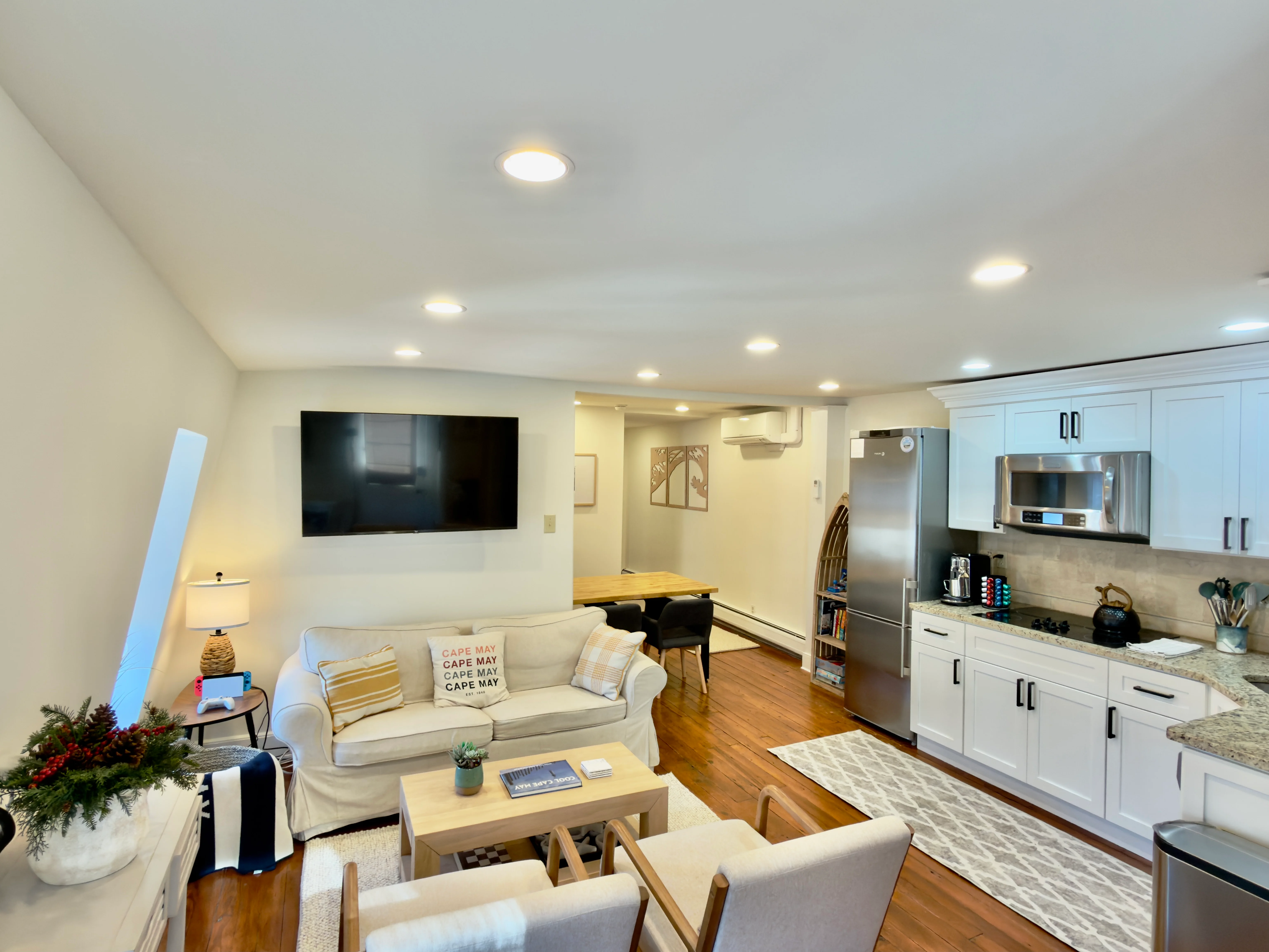
Specifically, Cape Belvedere sits on the top floor of the historic Belvedere building with Atlantic views, two bedrooms, two full bathrooms, and a unique cupola lounge for sunset watching. It accommodates up to 8 guests and includes four complimentary beach passes during the season. Two minutes from Congress Hall and one block from the beach, its location is hard to replicate at any price point. Booking directly at Cape del Mar means you pay the base rate without a 14% premium appended at checkout.
Cape Surf and Cape Whale are both in the historic Baronet Mansion on Beach Avenue, across the street from the ocean. Both are one-bedroom condos designed for couples or small families, both include beach tags and beach chairs, and both are pet-friendly. The savings from skipping Airbnb’s service fee on a peak-summer week at either property would realistically cover two dinners at a proper Cape May restaurant. Our Cape May restaurant guide tells you exactly where to spend them.
For two-bedroom options in the historic district, Cape Wave occupies the top floor of a Victorian house dating to 1860, with approximately 700 square feet, two bathrooms including an ensuite, a rooftop deck, and a five-minute walk to the beach. Cape Oar is an 800-square-foot apartment one block from Washington Street Mall with a private patio, a gourmet kitchen with a 4-seat island, and wheelchair accessibility. Both are bookable directly at no additional platform fee.
If location is your deciding factor, our guide to where to stay in Cape May by neighborhood helps narrow your search before you compare prices.
Does Direct Booking Savings Vary by Season in Cape May?
Yes, the dollar value of direct booking savings in Cape May is highest during peak summer, specifically July and the first two weeks of August, when nightly rates are at their peak. Airbnb’s service fee is a percentage of the total booking subtotal, so it scales directly with rate. A $350-per-night July stay carries a much larger service fee in absolute dollars than a $180-per-night October stay, even if the percentage is identical.
According to the Cape May County Tourism Conference Snapshot 2026, Cape May County welcomed 12.11 million visitors in 2026, up 4.6% from the year prior. Peak demand is concentrated between Memorial Day and Labor Day, when properties fill quickly and nightly rates peak. During that window, on a 7-night booking at $300 per night plus a $175 cleaning fee, Airbnb’s 14% service fee adds roughly $314 in fees alone. That same $314 could cover two nights in the shoulder season.
In contrast, a shoulder-season visit in late September or October carries lower base rates. The absolute savings from direct booking are smaller in dollar terms, but the percentage advantage is similar. And as noted above, some Cape May managers offer direct-only rates in shoulder months that carry an additional discount beyond simply removing the service fee, particularly for stays of four nights or more.
The off-season advantage compounds with experience: Cape May in October during the Jazz Festival, or in early May during the Spring Festival of Music, offers a genuinely different and less congested version of the town, often at rates 30: 40% below peak summer. Booking direct during those windows maximizes savings while giving you a Cape May that actually feels accessible.
FAQ: Direct Booking vs. Airbnb for Cape May Rentals
Is it cheaper to book a vacation rental direct or through Airbnb?
Yes, booking directly with the property manager is almost always cheaper. Airbnb adds a guest service fee of roughly 13, 17% on top of the nightly rate and cleaning fee. Many managers also raise their Airbnb nightly rate by 10, 15% to offset Airbnb’s 3% host fee, so the total markup a guest absorbs can exceed 20% compared to booking the same property directly.
How much can I save by booking a Cape May vacation rental directly?
On a typical 7-night Cape May stay at $200 per night, Airbnb’s service fee alone adds roughly $200, $220 to the checkout total. Savings of 10, 17% on the full booking cost are common, and some Cape May managers have reported differences exceeding 20% when comparing their direct rate to the same property’s Airbnb listing.
What does Airbnb charge guests in service fees?
According to Airbnb’s official fee documentation, the guest service fee is typically 13: 17% of the booking subtotal, which includes the nightly rate and cleaning fee. The exact percentage varies by trip length and location. Hosts on the standard split-fee model also pay approximately 3% on their side.
Are Cape del Mar properties bookable directly without Airbnb?
Yes. All Cape del Mar properties in Cape May and Cape Coral are bookable directly at capedelmar.com. Booking directly means no Airbnb service fee, direct communication with the hosts, and access to the full list of included amenities such as beach tags, stocked kitchens, and eco-friendly supplies.
Is it safe to book a vacation rental directly instead of through Airbnb?
Booking directly with a verified, established property manager is safe. Look for a professional website with clearly listed properties, verifiable photos, a stated cancellation and refund policy, and direct contact information. Cape del Mar’s Cape May properties include keyless entry, detailed house manuals, and responsive host communication. Reading recent guest reviews on third-party platforms before booking directly is also a sound due-diligence step.
Do Cape del Mar properties include beach tags when booked directly?
Yes. Cape Whale, Cape Surf, Cape Oar, Cape Belvedere, and Cape Wave all include complimentary beach passes during the season, typically Memorial Day through mid-September. These are included in the direct booking rate at no extra charge. Confirm with the specific listing for stays outside that seasonal window.
What is the 80/20 rule for Airbnb?
The Airbnb 80/20 rule is an industry-level observation that roughly 80% of a host’s revenue tends to come from about 20% of their calendar dates, typically peak weekends and high-demand holiday periods. It is not an official Airbnb policy, but property managers use it to justify premium pricing during peak periods and more flexible direct-booking discounts in shoulder seasons.
The Bottom Line: Where Your Money Goes
When you book a vacation rental through Airbnb, a meaningful portion of your travel budget goes to platform fees rather than the property itself, the host, or your experience once you arrive. The math is clear: Airbnb’s guest service fee of 13, 17%, often compounded by a host-side nightly rate inflation of 10, 15%, can add 20% or more to the total cost of a Cape May week. On peak-summer bookings, that figure translates to hundreds of dollars.
Booking directly with an established manager is the smarter financial move for travelers who have identified the property they want. It is also the better communication path: you deal with the actual host from the first inquiry, get accurate information about what is included, and have a direct line if anything needs attention during your stay.
In 2026, Cape May County continues to draw over 12 million visitors annually, with travelers spending an average of $365 per person per day for overnight stays. At that spending level, every dollar saved on platform fees is a dollar available for a dinner at Peter Shields Inn, a carriage tour through the Victorian district with Cape May Carriage Company, or simply an extra night. Direct booking is not just a frugal choice; it is the clearest path to a Cape May trip that delivers full value. Once you have locked in your accommodation, our roundup of things to do in Cape May covers activities for families, couples, and day-trippers alike.

Cape Belvedere’s top-floor Atlantic views and cupola lounge make it one of the most requested properties in Cape May’s historic district. The direct booking rate at Cape Belvedere includes everything: beach passes, stocked kitchen, organic toiletries, and fast Wi-Fi, no service fee appended at checkout. Browse all Cape del Mar properties and book directly at capedelmar.com.
]]>