
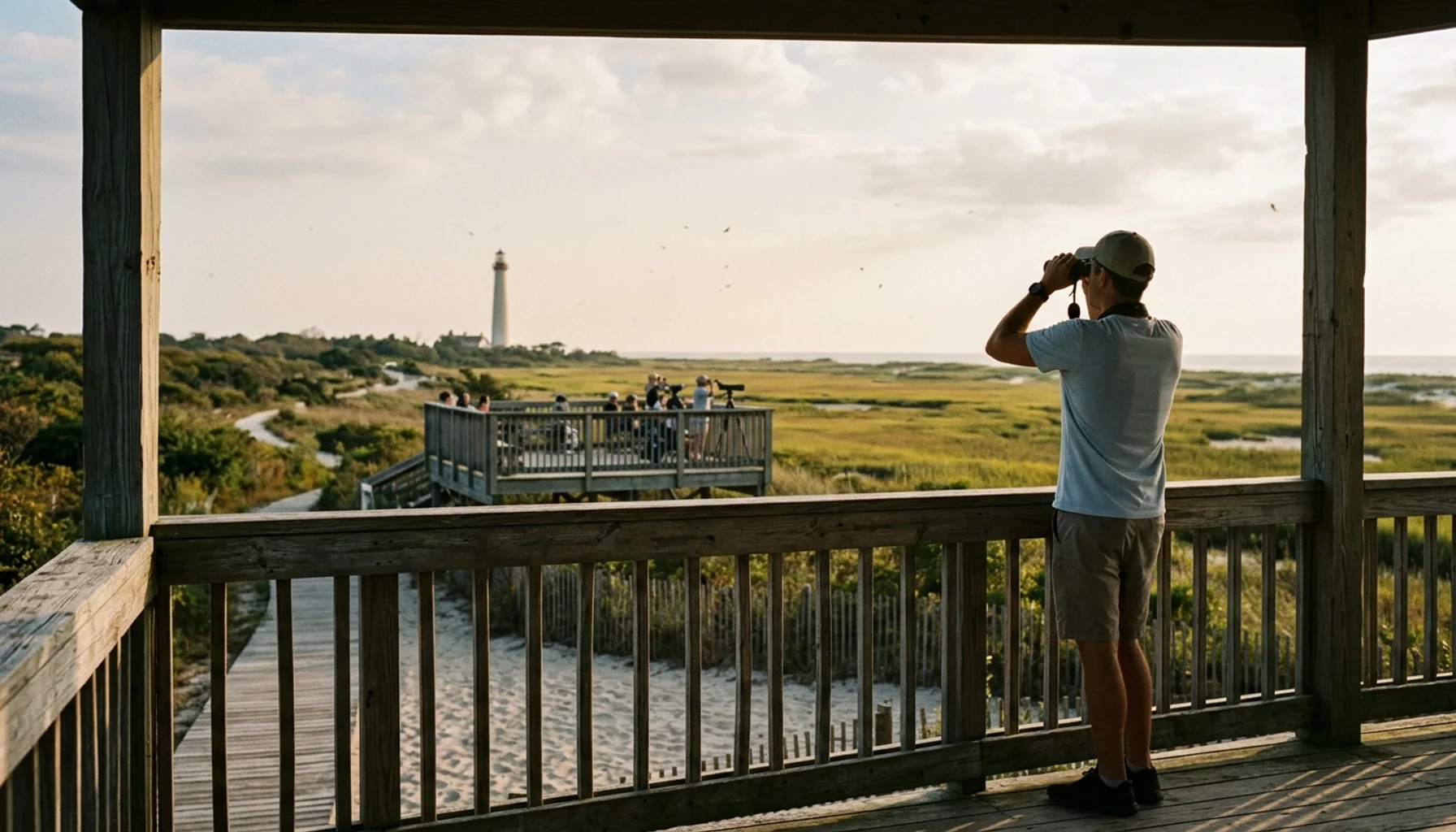
Is Cape May NJ worth visiting in the fall? Yes, and for most travelers it’s a better trip than summer. Between mid-September and late October, you get 60s-degree highs, a raptor migration that draws birders from across the country, thinner crowds on Washington Street Mall, and lodging rates that typically run $200 to $300 a night instead of $300-plus during peak summer weeks. Cape May County drew 12.11 million visitors in 2026, according to the county’s Tourism Economic Impact Book, and fall is where a growing share of that traffic now lands.
- Weather: fall highs in Cape May average around 66.6°F with lows near 51.9°F, and rain falls on only 1 to 2 days per month, making September and October some of the most comfortable weeks of the year.
- Birding: the Cape May Point State Park hawkwatch platform tallies an average of 30,000 to 45,000 raptors between mid-September and mid-November, alongside a monarch butterfly migration that passes through in the tens of thousands.
- Cost savings: off-season lodging often runs $200 to $300 a night versus $300-plus in peak summer, and Cape May’s average nightly short-term rental rate sits around $556 across the full year according to 2026 Airbnb platform data, meaning fall stays typically undercut that average significantly.
- Crowds: shoulder season occupancy for Cape May short-term rentals runs around 33 to 34%, a steep drop from the roughly 71% summer occupancy reported by Chalet’s 2026 market data, which translates directly into shorter waits at restaurants and easier beach parking.
- Events: fall brings the Fall Sidewalk Sales, Victorian Weekend in mid-October, the Lima Bean Festival, and a fall edition of the Exit Zero Jazz Festival, giving visitors a real calendar of things to plan around.
- Best fit: fall favors couples, birders, food-focused travelers, and anyone who wants Cape May’s Victorian architecture and beaches without July’s parking lines.
If you’ve spent a summer in Cape May fighting for a Washington Street Mall parking spot or waiting 45 minutes for a table at a Beach Avenue restaurant, fall solves both problems. The town doesn’t shut down after Labor Day the way some Jersey Shore towns do. It just gets quieter, cheaper, and arguably more interesting, especially if birds, wine, or a good porch rocking chair sound appealing to you.
At Cape del Mar, we host guests in Cape May’s historic district year-round, and fall is when we field the most questions about what’s actually open, what the weather really feels like, and whether the trip is worth planning around a raptor count or a jazz festival. Short answer: yes, and here’s the detail behind that answer, covering weather, events, birding, lodging costs, and the practical stuff most guides skip.
As of 2026, Cape May County tourism has climbed to roughly 12.03 to 12.11 million annual visitors with total spending near $8.4 billion, and shoulder-season visitation is a growing part of that number. Fall isn’t an afterthought anymore. It’s a strategy for anyone who wants the same beaches and Victorian streetscape without competing with peak-season crowds.
Is There Anything to Do in Cape May in October?
October in Cape May is full of things to do, ranging from raptor watching and wine tastings to Victorian house tours and ghost walks. Specifically, October combines peak hawk migration counts at Cape May Point State Park with the town’s Victorian Weekend, typically held in mid-October, and the annual Lima Bean Festival on October 11.
First, the birding is the headline act. The Cape May Bird Observatory and volunteers with New Jersey Audubon staff the hawkwatch platform daily through the season, and October is statistically the busiest month for raptor counts, with peregrine falcons, sharp-shinned hawks, and northern harriers moving through in the same window. Additionally, the Monarch Monitoring Project recorded sixteen dragonfly species and eighteen additional butterfly species during its fall 2026 point counts, so even non-birders walking the dunes at the point tend to see something interesting overhead.
For a change of pace, Beach Plum Farm runs hayrides, mulled cider, and pumpkin picking through the autumn months, which works well as a half-day activity if you’re traveling with kids or want something outside the historic district. As a result, an October trip can easily fill two or three days without repeating an activity, something summer visitors rarely manage once beach time gets factored in.
One honest caveat: several shops and smaller restaurants on Washington Street Mall shift to weekend-only hours by late October, so a Tuesday visit will feel noticeably quieter than a Saturday. Check hours before you go if you’re planning a weekday trip.

Is May a Good Time to Go to Cape May, NJ, Compared to Fall?
May is a good time to visit Cape May, but it’s a different trip than fall. Spring brings warming temperatures and the tail end of the spring shorebird migration, while fall delivers the more dramatic raptor spectacle and warmer water lingering from summer.
Specifically, spring and fall share nearly identical shoulder-season occupancy rates, with Cape May short-term rentals averaging around 33 to 34% occupancy in both seasons according to Getchalet’s 2026 market data. That means similar crowd levels and similar lodging deals whether you book a May weekend or an October one.
The difference comes down to what you want to see and do. May favors garden tours, the earliest boat trips, and milder ocean temperatures for anyone brave enough to swim. Fall, in contrast, favors the hawkwatch, wine harvest events, and the town’s Victorian architecture under fall foliage. Notably, the twice-yearly Exit Zero Jazz Festival runs in both spring and fall, so music lovers get two chances a year rather than one.
For budget-focused travelers, both seasons land in that $200 to $300 nightly lodging range instead of summer’s $300-plus rates. If you’re choosing between the two, pick spring for flowering gardens and mild starts, and pick fall for the raptor migration, harvest festivals, and a slightly more dramatic Atlantic under a lower autumn sun.
What Is the Prettiest Town on the Jersey Shore?
Cape May is widely regarded as the prettiest town on the Jersey Shore, largely due to its concentration of preserved Victorian architecture. The town’s historic district was designated a National Historic Landmark on May 11, 1976, one of the largest collections of late-Victorian buildings in the country.
Specifically, gingerbread trim, wraparound porches, and turret rooflines line streets like Columbia Avenue and Hughes Street, many dating to the 1870s and 1880s rebuilding boom that followed a major fire in 1878. Unlike newer shore towns built up with condo towers, Cape May’s building codes have protected this streetscape for decades, which is part of why it reads as more cohesive and photogenic than nearby resort towns.
Fall light is arguably the best time to see it. Lower autumn sun angles catch the porches and cupolas in a way that flattens out under the harsher midday light of July. If you’re staying in the historic district, an early morning walk before breakfast, before delivery trucks and tour trolleys fill the narrow streets, is worth the alarm clock.
For families or groups who want to be inside that architecture rather than just photographing it, Cape Oar sits inside a Victorian house dating to 1860, one block from Washington Street Mall, with a private patio that’s a genuinely nice spot for a fall morning coffee.
Which Is Nicer, Cape May or Wildwood?
Cape May and Wildwood serve different kinds of trips, and neither is objectively nicer, they’re built for different visitors. Cape May centers on Victorian architecture, quiet beaches, birding, and dining, while Wildwood is built around its boardwalk, amusement piers, and a livelier nightlife scene.
For fall specifically, this distinction matters more than in summer. Wildwood’s boardwalk attractions and amusement piers largely wind down after Labor Day, which can leave a fall visit feeling emptier than intended. Cape May, in contrast, keeps its historic district, restaurants, and birding infrastructure running through October and into November, since those draws were never dependent on summer amusement operations in the first place.
If your fall trip centers on quiet mornings, a good dinner, and maybe a lighthouse climb, Cape May is the stronger choice. If you’re chasing boardwalk energy and don’t mind a scaled-back off-season version of it, Wildwood remains an option, though it’s built for a different kind of traveler than the one asking whether Cape May is worth a fall visit.
What’s the Weather Actually Like in Cape May in Fall?
Cape May’s fall weather is mild and stable, with average highs around 66.6°F and lows near 51.9°F, and rain falling on only about 1 to 2 days per month. That combination makes September and October some of the most comfortable weeks of the year on the Jersey Cape.
Specifically, early September still carries some late-summer warmth, often into the mid-70s, while late October cools into the 50s during the day and can dip into the 40s overnight. As a result, layering matters more here than a single jacket choice. A light rain shell, a mid-weight sweater, and comfortable walking shoes cover almost every day in the season.
Ocean water temperatures hold onto summer warmth longer than air temperatures do, so early September swimming is still realistic, while by mid-October it’s better suited to beachcombing than actual swimming. The Cape May Beach Patrol typically wraps up lifeguard coverage around Labor Day, so anyone swimming after that is doing so without a lifeguard on duty, worth knowing if you’re traveling with kids.
Wind off the Atlantic picks up noticeably in October, which is actually good news for the hawkwatch crowd, since northwest winds after a cold front push more raptors past the point in a single day. For everyone else, it just means the porch rocking chairs at properties like Cape Belvedere earn their keep with a blanket close by.
What Fall Events and Festivals Are Worth Planning a Trip Around?
Cape May’s fall calendar includes several dated events worth building an itinerary around, including the Fall Sidewalk Sales, a Railways, Collectibles, and Craft Show, Victorian Weekend, and the Lima Bean Festival. Specifically, these events cluster in September and October, giving visitors natural anchor points for a two- or three-day trip.
| Event | Typical Timing | What to Expect |
|---|---|---|
| Fall Sidewalk Sales | Mid-September | Washington Street Mall shops discount summer inventory outdoors |
| Railways, Collectibles & Craft Show | Late September | Vendor market with local crafts and collectibles |
| Harvest Brew Fest | September | Beer tasting at the Emlen Physick Estate grounds |
| Oktoberfest on Jackson Street | Late September | Street festival with German food and beer vendors |
| Victorian Weekend | Mid-October (typically Oct 10-13) | Historic house tours and period-costume events |
| Lima Bean Festival | October 11 | Community food festival celebrating the local lima bean harvest |
| Exit Zero Jazz Festival (fall edition) | Late fall | Three-day jazz festival held twice yearly, spring and fall |
Notably, Cape May’s event calendar shifts year to year, so it’s worth checking the town’s official listings before locking in dates, especially for something like the fall jazz festival where venues can change. Ghost tours and haunted hotel walks also pick up through October, leaning into the town’s Victorian, slightly spooky atmosphere after dark.
Beach Plum Farm’s harvest activities, including hayrides and pumpkin picking, run without fixed festival dates through most of the fall, making it a reliable fallback if a specific festival weekend doesn’t line up with your travel dates.
How Does Fall Birdwatching in Cape May Compare to Summer Wildlife Viewing?
Fall birdwatching in Cape May centers on a raptor migration that peaks in late September and October, drawing visitors specifically for the spectacle rather than as a secondary activity. Cape May is recognized as one of North America’s premier birdwatching destinations, with the Delaware Bay and Atlantic coastline forming a natural funnel for migrating birds.
Specifically, the hawkwatch platform at Cape May Point State Park tallies an average of 30,000 to 45,000 individual raptors between mid-September and mid-November, according to counts referenced by the Cape May Bird Observatory. That includes peregrine falcons, sharp-shinned hawks, and northern harriers moving south along the coast. Additionally, monarch butterflies pass through in the tens of thousands during the same window, continuing on toward their overwintering grounds in Mexico.
Summer wildlife viewing, by contrast, centers on whale and dolphin watching cruises, which run from Miss Chris Marina through the warmer months. Cape May’s whale-watching season typically spans late spring through mid-fall, so a September trip can actually combine both, an early whale cruise and an afternoon at the hawkwatch platform, something a July visit can’t offer since raptor migration hasn’t started yet.
For accessibility, the hawkwatch platform sits on a flat, paved path from the park’s main parking lot, making it one of the more wheelchair-friendly nature experiences in the area. Bring binoculars if you have them; the park rents a limited number but supply runs out on busy weekend mornings.
What Does a Fall Cape May Trip Actually Cost Compared to Summer?
A fall trip to Cape May typically costs 20 to 35% less on lodging than a comparable summer stay, with off-season nightly rates commonly running $200 to $300 versus $300-plus during peak July and August weeks. That gap is the single biggest practical reason fall makes financial sense for a Jersey Shore trip.
Specifically, Cape May short-term rental hosts report average annual revenue near $52,884 with an average nightly rate around $556 across the full year, according to 2026 Airbnb platform data cited by AirROI. Since that yearly average blends peak summer premiums with much lower fall and winter rates, an actual fall booking tends to land well under that average figure. For a weekend trip, budgeting a minimum of around $600 for lodging alone remains a reasonable off-season estimate, before food, gas, and activities.
Restaurants also loosen up in fall. Reservation-only summer spots often start taking walk-ins again by mid-September, and parking on Beach Avenue, a genuine struggle in July, becomes manageable most weekdays. As a result, fall trips tend to feel less rushed and less expensive at almost every touchpoint, from the drive in to the dinner table.
One thing worth budgeting for regardless of season: beach tags. Fall beach walking is typically tag-free once the Cape May Beach Patrol season winds down, since tag enforcement generally follows lifeguard coverage windows rather than running year-round.

Where Should You Stay for a Fall Cape May Trip?
Choosing where to stay in Cape May for a fall trip comes down to prioritizing walkability, since fewer crowds mean the historic district’s restaurants and shops are genuinely pleasant to wander rather than something to fight through. Staying inside or near the historic district also puts you closest to the hawkwatch platform, Washington Street Mall, and the beach, without needing a car for most of your trip.
For couples or small groups chasing an ocean view without the July premium, Cape Belvedere sits on the top floor of the Belvedere building, two minutes from Congress Hall and a block from Washington Street Mall. Its rooftop cupola with lounge chairs is arguably the best fall sunset-watching perch in this price range, and by October the shared porch rockers stay empty enough that you’ll actually get one.
Families or small groups wanting a genuinely walkable Victorian stay should look at Cape Wave, a two-bedroom loft on the top floor of an 1860 Victorian house, five minutes on foot from the beach and one block from the mall, with a rooftop deck that catches fall’s lower sun angle beautifully in the late afternoon.
For couples wanting a compact, budget-conscious base right across from the sand, Cape Whale sits in the rear addition of the historic Baronet Mansion directly across from the beach, with a king bed and a fully stocked kitchen that makes fall grocery-run mornings simple. Its pet-friendly policy also makes it a solid pick if you’re one of the many fall visitors bringing a dog along for the cooler-weather walks.
If you’d rather have private outdoor space than an ocean view, Cape Oar‘s private patio inside its 1860 Victorian building is one of the few genuinely private outdoor spaces this close to Washington Street Mall, and its wheelchair-accessible layout is worth knowing about if mobility is a factor for your group.
Whichever property you choose, our team can point you toward local experiences worth booking ahead for fall, since some tours and tastings run limited schedules once the season turns.
What Should You Pack and Plan for Logistically?
Packing for a fall Cape May trip means planning for a 20 to 25 degree daily temperature swing, since mornings near 51.9°F warm into afternoons closer to 66.6°F by early afternoon. A layering system works better than any single jacket.
Specifically, pack a base layer, a mid-weight sweater or fleece, and a wind-resistant shell, since coastal wind picks up noticeably in October. Comfortable closed-toe shoes matter more than sandals once you’re past mid-September, especially for the unpaved sections near the Meadows and dune paths. A pair of binoculars is worth the suitcase space if birding is even a passing interest, since rental supply at the park is limited.
Logistically, several attractions shift to weekend-only or reduced weekday hours by late October, so check hours before building a weekday itinerary around a specific shop, tour, or restaurant. Additionally, some shared laundry facilities at historic-building rentals, including at the Baronet Mansion, run seasonally from April through October, so plan accordingly if you’re staying multiple weeks into November.
For accessibility, the Cape May County Beach Access Brochure details mobility accommodations including surf chairs, and the Cape May Beach Patrol’s free surf chair program remains a genuinely useful resource, though availability outside peak lifeguard season should be confirmed ahead of your visit.
Practical Guidance: How to Build a 2 to 3 Day Fall Itinerary
Building a fall Cape May itinerary works best around one anchor event per day rather than trying to pack in everything at once. Here’s a framework that balances birding, food, and downtime without overbooking.
- Day one morning: Arrive, check in, walk Washington Street Mall before lunch crowds arrive around noon. Grab coffee and get oriented while shops are quiet.
- Day one afternoon: Head to Cape May Point State Park for the hawkwatch platform. Late afternoon on a windy, post-cold-front day produces the best raptor counts.
- Day one evening: Dinner reservation at a Beach Avenue or Washington Street spot; fall is when many reservation-only summer restaurants start accepting walk-ins again.
- Day two morning: Early beach walk before breakfast, when the light is best for photographing the Victorian rooflines from the sand.
- Day two afternoon: Visit Beach Plum Farm for hayrides and pumpkin picking, or check if a fall festival like Victorian Weekend or the Lima Bean Festival falls on your travel dates.
- Day two evening: Ghost tour or ghost-themed trolley walk through the historic district after dark.
- Day three: Slow morning, second coffee on the porch, and a last walk through the waterfront before checkout.
Common mistakes to avoid: booking a weekday trip without checking shop hours first, skipping the binoculars if birding interests you at all, and assuming fall means the town shuts down, it doesn’t, it just slows down in a way that actually benefits visitors.
Frequently Asked Questions About Visiting Cape May in Fall
Is Cape May NJ worth visiting in the fall?
Yes. Fall brings mild weather around 66.6°F highs, a major raptor migration peaking in October, lower lodging rates typically in the $200 to $300 nightly range, and noticeably thinner crowds compared to summer’s roughly 71% occupancy.
What is the best month to visit Cape May in fall?
October is generally considered the best fall month, since it combines peak hawkwatch counts, the Victorian Weekend and Lima Bean Festival, and comfortable daytime temperatures, though nights get noticeably cooler by month’s end.
Do restaurants and shops stay open in Cape May during fall?
Most stay open, but many shift to weekend-only or reduced weekday hours by late October. Check specific hours ahead of a weekday visit, since this is one detail many guides skip.
Is Cape May crowded in the fall?
No, fall is significantly quieter than summer. Cape May short-term rental occupancy runs around 33 to 34% in fall versus roughly 71% in summer, according to 2026 market data, meaning shorter waits and easier parking.
Can you swim in Cape May in the fall?
Early September swimming is still comfortable since ocean temperatures lag air temperatures, but lifeguard coverage from the Cape May Beach Patrol typically ends around Labor Day, so later fall swimming happens without lifeguards on duty.
Is Cape May or Wildwood better for a fall trip?
Cape May holds up better for fall travel because its main draws, historic architecture, dining, and birding, don’t depend on summer amusement operations the way Wildwood’s boardwalk attractions do.
How much does a fall weekend in Cape May typically cost?
Budget a minimum of around $600 for lodging alone on a weekend trip, with nightly rates commonly running $200 to $300 in the off-season versus $300-plus during peak summer.
The Bottom Line on Visiting Cape May in Fall
Is Cape May NJ worth visiting in the fall? The evidence points firmly to yes. You get mild 66.6°F afternoons, a hawkwatch platform tallying tens of thousands of raptors, lodging typically 20 to 35% cheaper than summer, and a town that stays genuinely open, just quieter and more walkable.
Cape May County’s tourism numbers, now above 12 million annual visitors and $8 billion in spending as of 2026, show a destination that no longer treats fall as an afterthought. If you’ve only known Cape May in July, a fall trip will feel like a different, calmer version of the same town, and for most visitors, that’s the better version. Whether you’re chasing the raptor migration, a quieter version of Washington Street Mall, or simply a porch and a book without a summer premium attached, fall delivers all three.

If a fall trip built around the hawkwatch, quieter beaches, and lower rates sounds like your kind of visit, Cape Belvedere puts you two minutes from Congress Hall with a rooftop cupola that’s arguably the best seat in town for watching an October sunset. Check availability here whenever you’re ready to plan your stay.