

Cape May Ave refers to a residential and walkable corridor within Cape May, New Jersey’s historic district, an area anchored by Victorian architecture, proximity to the beach, and easy access to the Washington Street Mall. Visitors searching this term are usually trying to orient themselves within Cape May’s compact downtown grid before booking a rental or planning a walking route.
- Location context: Cape May Ave sits within Cape May’s National Historic Landmark district, designated on May 11, 1976, a distinction covering late-Victorian architecture across the downtown core.
- Visitor volume: Cape May County welcomed a record 12.11 million visitors in 2026, a 4.6% increase over 2023, according to the county’s Tourism Economic Impact Report.
- Spending data: Visitor spending in Cape May County reached $8.102 billion in 2026, with overnight visitors spending an average of $365 per person per day.
- Rental market: The county’s short-term rental median nightly rate runs around $348 with roughly 65% average annual occupancy, per recent STR dashboards.
- Practical takeaway: Streets in and around this corridor are walkable to the beach and Washington Street Mall, with parking that mixes dedicated off-street spots and metered or permit street parking depending on the block.
- Where to stay: Several Cape del Mar properties, including Cape Oar and Cape Belvedere, sit within a few blocks of this general area.
If you’ve landed here after seeing a real estate listing or a street name pop up while planning a Cape May trip, you’re not alone. Cape May Ave is one of several named streets threading through the city’s historic grid, and it comes up often in property records precisely because homes here trade at a premium tied to walkability and landmark status. This guide covers what the street is, why it matters for visitors, and how it compares to similarly-named streets elsewhere in the country, since a Cape May Ave also exists in San Diego’s Ocean Beach neighborhood and can cause confusion in search results.
At Cape del Mar, our properties sit inside this same historic district, which means guests ask us about street orientation, parking logistics, and walking distances constantly. We manage rentals across Cape May’s Beach Avenue corridor and the Washington Street Mall area, so we field these questions daily and can speak to them with the kind of specificity a general tourism site can’t. As of 2026, this remains one of the more walkable pockets of the entire Jersey Cape.
What Is Cape May Ave and Where Is It Located?
Cape May Ave is a residential street within Cape May, New Jersey’s historic district, positioned near the city’s downtown core and within reasonable walking distance of the beach and Washington Street Mall. The street falls inside the boundaries of the National Historic Landmark designation granted in 1976, meaning nearby homes reflect the late-Victorian architectural character the city is known for.
Unlike Beach Avenue, which runs directly along the oceanfront, Cape May Ave sits a block or more inland, in the residential fabric of the historic district. Specifically, homes along this stretch tend to be single-family houses rather than the converted mansions-turned-condos you’ll find closer to the water. As a result, the street reads more like a quiet neighborhood block than a tourist thoroughfare, even though it’s a short walk from the action.
For context, real estate listings for addresses like 1257 Cape May Ave describe a roughly 3,000-square-foot, 5-bedroom, 2.5-bath home on an 8,125-square-foot lot, marketed specifically for its proximity to the beach, the downtown historic district, Washington Street Mall, restaurants, and theaters, according to Realtor.com listing data. That combination of privacy plus proximity is exactly what makes this pocket of Cape May desirable in 2026.
How Does Cape May Ave Compare to Cape May’s Beach Avenue Rentals?
Cape May Ave and Beach Avenue serve different functions within the same historic district: Beach Avenue runs along the oceanfront with direct beach access, while Cape May Ave sits inland in a quieter residential pocket. Travelers booking a vacation rental typically prioritize Beach Avenue or streets immediately adjacent to it for the shortest walk to the sand.
If you want to be inside the actual footprint of a converted historic mansion, look at properties along Beach Avenue itself. The historic Baronet Mansion, for example, houses both Cape Whale and Cape Surf, two renovated condos positioned directly across from the beach. Cape Whale occupies the first floor rear addition with a king bed and pet-friendly policy, while Cape Surf sits on the second floor and includes two complimentary beach tags plus beach chairs and an umbrella, a detail that matters more than people expect once you’re hauling gear across sand in July.
By contrast, a residential street like Cape May Ave trades some of that beachfront immediacy for larger lot sizes and single-family privacy, which appeals more to buyers than renters. For a vacation stay, most visitors are better served by the Beach Avenue cluster or the Washington Street Mall corridor, where walkability to dining and shops is unbeatable.
What Should Visitors Know About Parking and Walking Access?
Parking near Cape May’s historic district, including streets like Cape May Ave, typically combines dedicated off-street spots at individual properties with metered or permit-only street parking during peak season. As of 2026, Cape May enforces seasonal parking restrictions from roughly late May through early September, and street spots in the historic core fill quickly on summer weekends.
Specifically, if you’re renting a car for your trip, plan to arrive with a property that includes off-street parking rather than relying on street spots alone. Cape Oar, an 800-square-foot renovated apartment inside an 1860 Victorian house one block from Washington Street Mall, includes one dedicated off-street parking space plus additional street parking, which takes the guesswork out of a Saturday afternoon arrival.
Walking access is the bigger draw here. Additionally, most addresses within the historic grid, Cape May Ave included, sit within a 10 to 15 minute walk of the beach and the Mall. That’s short enough to leave the car parked for your entire stay, which is one reason repeat visitors gravitate toward this part of town rather than renting further out near the harbor.

What Is the Historic and Neighborhood Context of Cape May’s Landmark District?
Cape May’s historic district, the broader area encompassing streets like Cape May Ave, earned National Historic Landmark status on May 11, 1976, recognizing it as one of the best-preserved collections of late-Victorian architecture in the United States. This designation covers the majority of downtown Cape May, including the Baronet Mansion and the buildings lining the Washington Street Mall.
As a result, homes and rentals within this footprint operate under guidelines that affect everything from exterior modifications to signage, which is part of why the neighborhood has retained its character instead of giving way to modern condo towers. For example, several Cape del Mar units, including Cape Whale and Cape Surf, occupy additions to the Baronet Mansion itself, a structure whose Victorian-era bones are part of what guests come to see.
The practical upshot for visitors: walking the blocks around Cape May Ave and neighboring streets doubles as a self-guided architecture tour. Bring a camera. Many of the preserved facades date to the 1800s, and the city’s compact grid means you can cover a meaningful stretch of the historic district on foot in under an hour.
How Does Cape May, NJ’s Cape May Ave Differ From Cape May Ave in San Diego?
Cape May Ave in Cape May, New Jersey is a residential street inside a National Historic Landmark district, while Cape May Ave in San Diego, California runs through the Ocean Beach neighborhood near Mission Bay, an entirely separate coastal community roughly 2,700 miles away. The two share a name and a coastal setting, but little else.
Specifically, property listings from San Diego’s Cape May Ave, such as addresses in the 92107 ZIP code, describe homes marketed for ocean and Mission Bay views, with realty services provided locally by CENTURY 21 Affiliated. One listing at 4450 Cape May Avenue was advertised as available for the first time since 1962, a detail that speaks to San Diego’s mid-century coastal development pattern rather than the Victorian-era history that defines Cape May, New Jersey.
If you searched this term hoping to plan a trip, the New Jersey version is almost certainly your destination: it’s tied to a defined tourism economy, a historic district, and a walkable downtown, whereas the California street is a residential real estate corridor within a much larger metro area. Confusing the two is an easy mistake given how many towns along the American coastline share directional or seasonal place names.
What Community Businesses and Events Are Near the Historic District?
The blocks surrounding Cape May Ave benefit from proximity to Washington Street Mall, a pedestrian shopping and dining corridor that anchors most visitor activity in downtown Cape May. This walkable stretch puts dozens of restaurants, boutiques, and seasonal events within a short stroll of the historic residential streets.
For dining, longtime favorites within walking distance include Mad Batter for breakfast and all-day fare, The Merion Inn, an 1885 historic inn known for cocktails and nightly live music, and Ugly Mug, a casual local pub popular with residents rather than just tourists. For something sweeter, Margie D’s Soda Fountain inside Della’s 5 and 10 on the Mall is a nostalgic stop worth the short detour.
Seasonal events also draw crowds to this part of town, extending demand well beyond peak summer. Notably, shoulder-season activity around events like the Cape May Jazz Festival and the area’s reputation as one of North America’s top birding destinations, per National Geographic’s recognition, helps stretch the visitor season into May, June, September, and October. If you’re weighing when to visit, our guide to things to do in Cape May breaks down seasonal programming in more depth.
Where Should You Stay Near This Part of Cape May?
The best base for exploring the historic district and walkable streets like Cape May Ave is a rental within a few blocks of Washington Street Mall or Beach Avenue, since both offer the shortest walk to dining, shopping, and the beach. Cape del Mar manages five properties within this footprint, each suited to different group sizes and priorities.
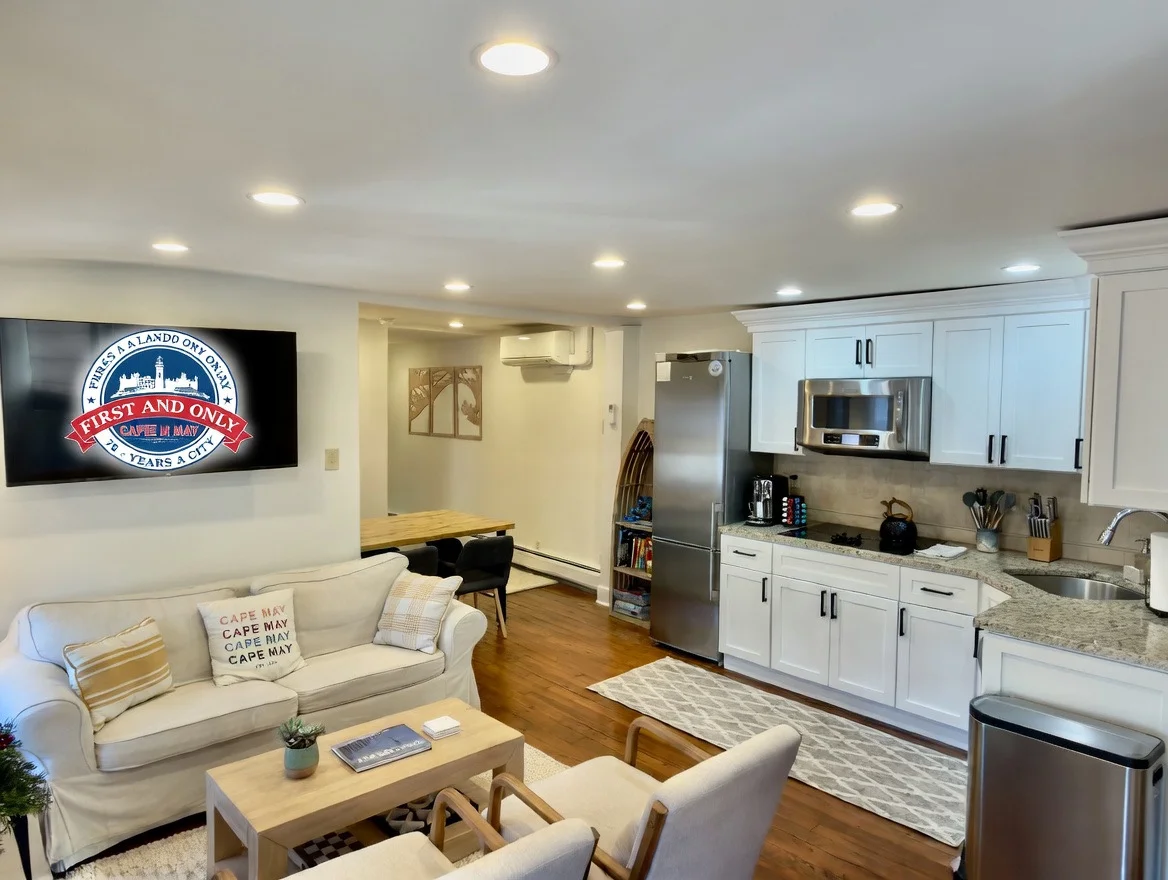
For couples wanting sweeping ocean views, Cape Belvedere is a top-floor 2-bedroom, 2-bathroom condo two minutes from Congress Hall with a private cupola lounge for sunset watching, sleeping up to 8 guests. Families or friend groups after historic charm should look at Cape Wave, a renovated loft in an 1860 Victorian home just a 5-minute walk to the beach, with a queen bed plus two twins across two bedrooms.
For anyone traveling with a dog, Cape Whale and Cape Surf are both pet-friendly and sit directly across from the beach inside the historic Baronet Mansion. And for a wheelchair-accessible option with a private patio, Cape Oar puts you one block from the Mall in an 800-square-foot layout. For a broader breakdown of which pocket of town fits your travel style, see our neighborhood-by-neighborhood guide to where to stay in Cape May.
| Property | Bedrooms/Bathrooms | Max Guests | Best For |
|---|---|---|---|
| Cape Belvedere | 2 bed / 2 bath | 8 | Couples, ocean views |
| Cape Wave | 2 bed / 2 bath | 4 | Families, historic charm |
| Cape Whale | 1 bed / 1 bath | 2 | Pet-friendly couples |
| Cape Surf | 1 bed / 1 bath | 2 | Pet-friendly, beach gear included |
| Cape Oar | 1 bed / 1 bath | 4 | Accessible, private patio |
What Practical Details Should You Plan Around Before Visiting?
Practical logistics around Cape May’s historic district include seasonal parking permits, limited shared laundry windows at some rentals, and higher visitor volume during peak summer weekends. Planning around these details in advance saves real frustration once you’ve arrived.
For example, shared coin-operated laundry at properties like Cape Whale and Cape Surf runs from April 1 through October 30 only, so winter guests should pack accordingly rather than expect on-site laundry access. Beach tags are also required for beach access from Memorial Day through Labor Day; several Cape del Mar properties, including Cape Belvedere and Cape Oar, include complimentary seasonal beach passes, which is worth confirming before you buy your own at the beach entrance.
Additionally, active military members and veterans qualify for free beach tags under a program detailed on the City of Cape May’s official beach tag page, a detail many visitor guides overlook. If mobility is a concern, the Cape May Beach Patrol offers free surf chairs for guests with restricted mobility, and the county’s official Beach Access Brochure outlines accessible parking and entry points in more detail.
How Should You Plan a Multi-Day Trip Around This Area?
Planning a multi-day trip around Cape May’s historic district works best when you treat the Washington Street Mall corridor as your home base and radiate outward on foot or by short bike ride. Most first-time visitors underestimate how much of Cape May is genuinely walkable once they’ve checked into a rental.
First, book a property within a few blocks of Beach Avenue or the Mall. Second, plan at least one full day around the beach itself, factoring in tag purchases and, if needed, gear from a local rental service like Geared Up Rentals, which delivers bikes and beach equipment directly to your rental on check-in day. Third, budget an evening for dinner at one of the historic dining rooms nearby, such as Blue Pig Tavern at Congress Hall or Ebbitt Room at the Virginia Hotel.
For a longer stay, our complete first-timer’s guide to planning a trip to Cape May walks through a full itinerary framework, and our restaurant guide organized by budget and occasion is worth bookmarking before you go, since dining options range widely from BYOB spots to fine dining destinations like Peter Shields Inn.
Frequently Asked Questions About Cape May Ave
Is Cape May Ave close to the beach?
Cape May Ave sits within Cape May’s historic district, typically a short walk of roughly 10 to 15 minutes from the beach and Washington Street Mall, though exact distance depends on the specific block. Beach Avenue itself, which runs directly along the oceanfront, is the more immediate option for beachfront access.
Is there more than one Cape May Ave?
Yes. Cape May Ave in Cape May, New Jersey sits inside a National Historic Landmark district near the Jersey Shore, while a separate Cape May Ave runs through the Ocean Beach neighborhood in San Diego, California. The two streets are unrelated beyond sharing a name.
What is the historic district designation tied to this area?
Cape May’s historic district was designated a National Historic Landmark on May 11, 1976, recognizing its collection of preserved late-Victorian architecture. This designation covers much of downtown Cape May, including the streets and buildings surrounding the Washington Street Mall.
Where should I stay if I want to be near the historic district?
Properties near Beach Avenue or the Washington Street Mall put you within easy walking distance of the historic district’s core. Cape del Mar manages several options in this footprint, including Cape Belvedere, Cape Wave, and Cape Oar, each suited to different group sizes.
Do Cape May rentals near the historic district allow pets?
Some do and some don’t, so it’s worth checking per property rather than assuming. Cape Whale and Cape Surf, both inside the historic Baronet Mansion, welcome well-behaved pets, while other Cape del Mar properties in the same area do not.
What is the best time of year to visit this part of Cape May?
Shoulder seasons in May, June, September, and October offer fewer crowds while still supporting active dining and shopping along Washington Street Mall. Cape May County recorded 12.11 million visitors in 2026, with day trips growing faster than overnight stays, so weekday visits even in shoulder months tend to feel quieter.
Is parking difficult near Cape May Ave and the historic district?
Parking combines off-street spots at individual properties with metered or permit street parking, and availability tightens considerably during summer weekends. Booking a rental with dedicated off-street parking, like Cape Oar, removes much of the uncertainty.
How much does an average visitor spend in Cape May County?
According to the county’s 2026 Tourism Economic Impact Report, the average visitor spends $669.07 per trip, with overnight visitors spending an average of $365 per person per day. These figures cover lodging, dining, recreation, and shopping combined.
Final Thoughts on Cape May Ave and the Historic District
Cape May Ave is best understood as one thread in Cape May’s larger historic district, a walkable, landmark-protected pocket of New Jersey’s Jersey Cape that rewards visitors who plan around parking, beach tags, and seasonal timing rather than winging it. With Cape May County’s tourism economy topping $8.1 billion in 2026 and growing again into 2026, this corridor isn’t slowing down, and booking early for peak summer weekends remains the smartest move.
Whether you’re chasing quiet historic streets, easy beach access, or a kitchen stocked well enough to skip the grocery run, the blocks around Cape May Ave reward a little planning. At Cape del Mar, we’ve built our properties around exactly this kind of trip: walkable, well-equipped, and genuinely low-hassle from check-in to check-out.

If you’re planning a stay near the historic district, Cape Belvedere puts you two minutes from Congress Hall and a block from Washington Street Mall, with a private cupola perfect for watching the sun set over the rooftops. Whenever you’re ready to plan your stay, check availability at Cape Belvedere.