

A vacation rental is worth it once you have four or more travelers staying four or more nights, because the cleaning fee spreads thin and a kitchen starts cutting real money off your food bill. Below four nights or below four guests, a hotel usually wins on total cost and convenience.
Key Takeaways
- Vacation rentals typically become cost-effective around night four, once the cleaning fee is spread across enough nights to stop dominating the per-night rate.
- A family of four splitting a rental instead of booking two hotel rooms at $350+ per night combined can cut lodging costs substantially, and a fully stocked kitchen can trim a roughly $2,800 weekly food bill in half.
- For a group of eight, a $2,000-per-night rental works out to $250 per person, versus $700 or more per person for four separate hotel rooms.
- Solo travelers and couples on trips of one to three nights generally get better value from a hotel, where there’s no cleaning fee to amortize and front-desk support handles problems instantly.
- Cape May, NJ properties like Cape Belvedere and Cape Pelican in Cape Coral, FL illustrate how location, kitchen access, and group capacity change the math for real travelers.
- Cape May County drew 12.11 million visitors in 2026, spending $8.1 billion, according to the Cape May County Government Tourism Economic Impact Book, a sign that demand for both hotels and rentals here keeps climbing.
If you’ve spent any time comparing a beach house against a hotel suite for your next trip, you’ve probably landed on the same question everyone lands on: is a vacation rental actually worth it, or is that extra bedroom and kitchen just marketing dressed up as value? The honest answer depends less on the destination and more on your headcount and how many nights you’re staying.
At Cape del Mar, we manage renovated condos and homes across Cape May, New Jersey and Cape Coral, Florida, and we get asked some version of this question almost daily, usually from a family trying to decide between a hotel suite and a full apartment three blocks from the beach. So we ran the actual numbers: cleaning fees, kitchen savings, per-person splits, and the break-even point where a rental starts winning.
This guide walks through the math for different group sizes and trip lengths, covers the two most common comparison frameworks people search for (the 2% rule and the 75-55 rule), and digs into the questions that generic advice columns tend to skip, like how to vet a host beyond star ratings and what actually differs between Airbnb and Vrbo for the same property. By the end, you’ll have a framework you can apply to your own trip, whether that’s a weekend in Cape May or a two-week stay in Southwest Florida.
Is a Vacation Rental Worth It for a Typical Family Trip?
A vacation rental is worth it for a typical family of four on a stay of four nights or longer, mainly because splitting one nightly rate across the group beats paying for two hotel rooms, and a kitchen lets you skip several restaurant meals. Specifically, a family needing two hotel rooms at $350 or more per night combined can instead book one rental and split that cost across the same four people.
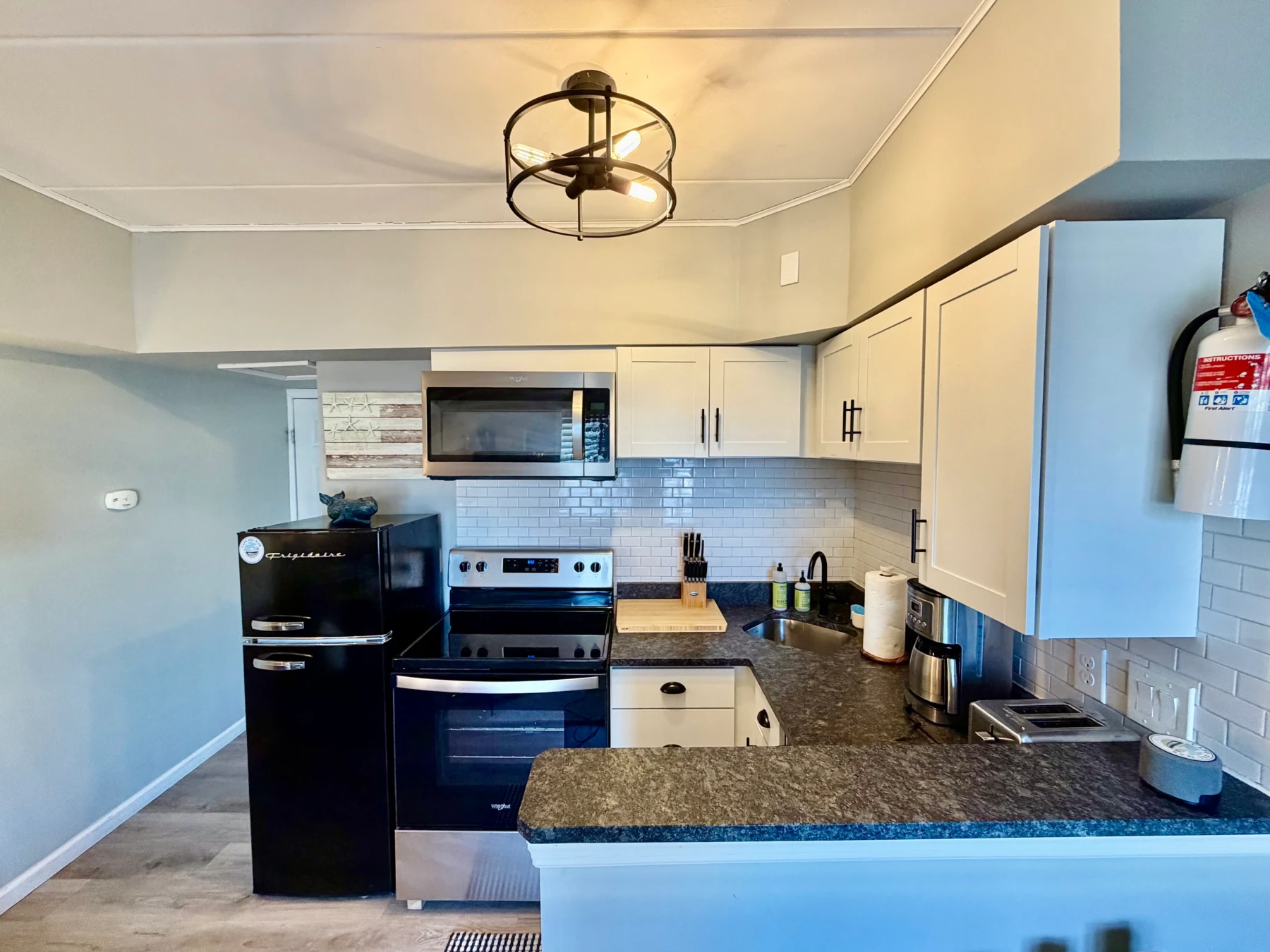
The kitchen is where the real savings show up. A family’s food bill on a week-long beach trip often runs close to $2,800 when every meal is a restaurant meal, but cooking breakfast and a handful of dinners at the rental can cut that number roughly in half. That’s not a minor detail; it’s frequently the single largest line item that tips the math toward a rental.
As a result, properties built around real kitchens matter more than glossy photos. Cape Pelican in Cape Coral, FL sleeps up to 10 guests across 4 bedrooms and 2 bathrooms, with a full kitchen, an 8-person dining table, and a 4-person breakfast bar, the kind of setup that makes cooking for a crowd realistic instead of theoretical. For Cape May families who want a comparable setup on a smaller scale, Cape Wave offers 2 bedrooms and 2 bathrooms for up to 4 guests with a fully equipped kitchen a five-minute walk from the beach.
What Is the 2% Rule for Rentals?
The 2% rule is an investment guideline stating that a rental property’s monthly rental income should equal at least 2% of its purchase price for the investment to generate strong cash flow. For example, a $300,000 property would need to bring in roughly $6,000 per month to satisfy the rule.
This rule was built for long-term residential rentals, not short-term vacation rentals, so it translates loosely at best to a beach house or condo bought for Airbnb or Vrbo use. Short-term rental income is seasonal and occupancy-dependent, unlike a 12-month lease with a fixed rent check. A Cape May condo might hit strong weekly rates from June through August and sit mostly empty in January, which the 2% rule doesn’t account for.
If you’re evaluating a vacation rental as an investment rather than as a place to stay, break-even occupancy and cash-on-cash return are more accurate tools, and we cover both in detail later in this guide. As a general guideline, experienced short-term rental operators typically target an annual cash-on-cash return of 8 to 12% or higher on a leveraged purchase, though many properties fall short of that benchmark in their first year while pricing and occupancy strategy mature.
What Is the 75-55 Rule for Airbnb?
The “75-55 rule” isn’t a standardized industry formula the way the 2% rule is; it’s a shorthand some hosts and forum threads use to estimate that occupancy needs to land somewhere in the 55% to 75% range for a short-term rental to comfortably cover its costs and turn a profit, though the specific numbers shift by market. Rather than memorizing a fixed rule, calculate your property’s actual break-even occupancy using its real numbers.
Break-even occupancy is the minimum percentage of nights per year a rental needs to book to cover both fixed costs (mortgage, insurance, property taxes, a flat management fee) and variable costs at full occupancy (cleaning, utilities, supplies, platform fees). To calculate it, add up your annual fixed costs, then divide by the difference between your average nightly rate and your per-stay variable cost, then divide that result by 365.
Market data matters more than a rule of thumb here. According to AirROI’s 2026 dataset covering June 2026 through May 2026, the average annual revenue for a typical Airbnb in Cape Coral, FL is $28,631 at a 37.0% occupancy rate and an average nightly rate of $299. Notably, AirROI also reports that strong-performing Cape Coral properties, the top 25%, maintain 60% occupancy or higher, a wide gap that shows how much location, pricing strategy, and presentation separate an average listing from a thriving one.
Which Is Better, Airbnb or Vacation Rental by Owner?
Airbnb and Vrbo (Vacation Rental by Owner) are both legitimate platforms for booking a short-term rental, and neither is universally “better”; the right choice depends on what you’re comparing for the same property. Airbnb has roughly five million hosts listing properties worldwide as of 2026 and has processed over 2.5 billion guest arrivals, according to Statista, giving it a larger inventory and more built-in review infrastructure. Vrbo tends to skew toward whole-home listings and families, since it historically hasn’t allowed shared-room or single-room bookings the way Airbnb does.
For guests, the practical differences come down to calendar consistency, host communication standards, and how a specific property prices across platforms. Some hosts, including many independent operators, list the same property on both platforms and sync calendars through channel management software, but pricing and availability can occasionally drift out of sync between the two. Before booking, check whether the host communicates quickly (response time is usually visible on the listing) and whether the cancellation policy matches what you need.
At Cape del Mar, we book many stays directly rather than exclusively through either platform, which lets us skip third-party service fees and communicate with guests before and during their stay without a platform intermediary. If you’re weighing a direct booking against an OTA listing for the same Cape May condo, ask the host directly what the total cost looks like both ways; the difference is often more meaningful than people expect.
What Are Common Issues With Vacation Rentals?
Common issues with vacation rentals include inconsistent cleaning quality between stays, listing photos that don’t match the actual property condition, slow host response times during a stay, and confusion over check-in instructions for self-service properties. Specifically, guests most often run into trouble when a host is unresponsive to maintenance issues or when a listing’s amenities (like a promised parking spot or working laundry) turn out to be inaccurate or seasonal.
Seasonal limitations trip up more guests than you’d think. For example, shared laundry facilities at historic properties, including several in Cape May’s Baronet Mansion complex, typically run from April 1 through October 30 and aren’t available in the off-season. A guest booking a December stay who assumes year-round laundry access will be disappointed, which is exactly the kind of detail a listing should disclose upfront rather than burying in the fine print.
Other frequent friction points include unclear pet policies (a property might welcome dogs but restrict them from furniture), parking that’s described as “available” but turns out to be street parking only during peak season, and self-check-in systems that fail if a guest arrives outside the stated window. Reading the full listing description, not just the headline amenities, solves most of these before they become a problem.
How Do You Compare the Real Cost of a Vacation Rental vs. a Hotel?
Comparing a vacation rental against a hotel requires adding every fee on both sides, not just the advertised nightly rate. Specifically, a hotel comparison needs to include parking fees, resort fees, breakfast costs if not included, and the price of eating most meals out, while a rental comparison needs the cleaning fee, any service fee, and taxes.
| Scenario | Better Option | Key Cost Factor |
|---|---|---|
| Solo business traveler, 1-2 nights | Hotel | No cleaning fee to amortize; front-desk support handles issues immediately |
| Couple, weekend getaway, 2-3 nights | Usually hotel | Rental only wins if privacy or in-room cooking matters more than convenience |
| Family of four, 4-7 nights | Vacation rental | One rental split four ways beats two hotel rooms; kitchen cuts food costs |
| Group of eight, any length over 3 nights | Vacation rental | $2,000/night rental split 8 ways = $250/person vs. $700+/person for separate rooms |
| Extended stay, 7+ nights | Vacation rental | Dedicated workspace, full kitchen, and room to spread out favor remote work and longer stays |
| Last-minute international trip, 1-2 nights | Hotel | Immediate booking, language support, no host verification delays |
Here’s a real-world version of that math. A family of four visiting Cape May for a week might pay $350 per night for two hotel rooms, or roughly $2,450 for seven nights, plus parking and most meals out. The same family in Cape Wave, a two-bedroom, two-bathroom loft in an 1860 Victorian a five-minute walk from the beach, pays one nightly rate for the whole unit and cooks breakfast most mornings in a fully equipped kitchen, cutting into that roughly $2,800 weekly food bill families often rack up eating out for every meal.
Break-even generally arrives around night four. Below that, the cleaning fee (often $100-200 for a mid-size rental) eats a disproportionate share of the total cost. Once you’re past four nights, that fee has spread thin enough that the per-night math starts favoring the rental, assuming the group is large enough to make splitting worthwhile in the first place.
When Is a Vacation Rental Worth It for Solo Travelers?
A vacation rental is worth it for a solo traveler primarily on stays of a week or longer, especially for remote work, because a private one-bedroom unit with a dedicated desk and full kitchen often costs less per night than a hotel over an extended stretch while offering more workspace and privacy. On shorter trips of one to three nights, a hotel almost always wins for a solo guest, since there’s no group to split the cleaning fee across and front-desk service resolves problems on the spot.
This is a scenario most generic guides skip entirely, but it matters for the growing number of remote workers treating a beach town as a temporary office. A one-bedroom unit like Cape Whale, with a laptop desk in the bedroom, high-speed WiFi, and a kitchen stocked with cooking essentials, functions as a real workspace rather than just a place to sleep. At roughly a week or longer, the math shifts because you’re no longer paying a flat cleaning fee against just one or two nights of use, and you’re also skipping the cost of eating every meal out.
Solo travelers should also weigh accessibility and layout. Cape Oar, an 800-square-foot wheelchair-accessible apartment inside an 1860 Victorian one block from Washington Street Mall, works well for a solo traveler who wants a private patio and doesn’t need multiple bedrooms. For a Northeast weekend escape from Philadelphia or New York rather than a long stay, though, a hotel or a short two-night rental stay usually makes more financial sense than trying to force the extended-stay math onto a short trip.
How Do Local Regulations Affect Whether a Rental Is Worth It?
Local zoning and short-term rental regulations directly affect whether a specific property can legally operate as a vacation rental at all, which matters both for guests booking with confidence and for anyone considering buying a rental as an investment. Regulation profiles vary sharply even between neighboring towns; a rule that applies in Cape May City may not apply the same way in West Cape May or Cape May Point.
If you’re a traveler simply booking a stay, this mostly matters as a trust signal: a host who operates transparently and has clearly registered their property tends to run a more reliable operation overall. If you’re considering buying a property to rent out yourself, confirm zoning and permitting directly with the relevant municipal office rather than relying on general online guidance, since requirements and licensing rules change and differ block by block in coastal towns.
Insurance is the other piece people underestimate. Premiums for a vacation rental can vary dramatically based on flood zone designation and construction type, which is especially relevant along the Jersey Shore and in coastal Florida markets like Cape Coral. Before assuming a property “pencils out” as an investment, get a real insurance quote tied to the property’s actual flood zone rather than a citywide average.
How Do You Vet a Host or Property Beyond Star Ratings?
Vetting a vacation rental host beyond star ratings means checking response time, reading recent reviews (not just the overall score), and confirming specific amenities directly with the host before booking. A 4.8-star average tells you little if it’s built on five reviews from two years ago; look instead at review recency and whether recent guests mention issues like cleanliness, accuracy of photos, or communication delays.
Ask direct questions before booking: is parking guaranteed or shared, is the kitchen fully stocked or does it need groceries for basics, and what’s the actual check-in process. A host who answers quickly and specifically, rather than with a generic copy-paste response, is usually a better signal of the actual guest experience than the star rating itself. At Cape del Mar, we communicate directly through the booking platform’s messaging and respond quickly to pre-stay questions, since a fast, specific answer before you book tells you more than any review count.
Cross-check listing claims against neutral sources when possible. If a Cape May listing claims a beach tag is included, the City of Cape May’s official beach tag page confirms current requirements and whether tags are needed at all during your travel dates. For pet policies, a quick search of local borough code, like the documented promenade dog rules, tells you whether a host’s pet-friendly claim actually holds up against local law.
What Should You Prioritize When Deciding Between a Rental and a Hotel?
Deciding between a vacation rental and a hotel comes down to four factors in order of importance: group size, trip length, whether you plan to cook, and how much you value privacy versus front-desk convenience. Work through these in sequence rather than starting with price alone, since price differences typically resolve themselves once you’ve answered the first three questions honestly.
- Count your actual group size. Two or fewer travelers rarely benefit from a rental’s per-person split advantage; four or more almost always do.
- Confirm your trip length. Under four nights, the cleaning fee usually outweighs kitchen savings. Four nights or more, the math starts favoring a rental.
- Decide honestly whether you’ll cook. A rental’s biggest financial advantage disappears if the kitchen sits unused and you eat every meal at a restaurant anyway.
- Weigh convenience against privacy. Solo or last-minute international travelers benefit from a hotel’s immediate check-in and language support; families and groups usually value a private whole-home space more.
- Add every fee on both sides before comparing totals. Include parking, resort fees, and meals for hotels; include cleaning fees, service fees, and taxes for rentals.
- Check local regulations and reviews if you’re comparing multiple rental listings. A well-reviewed, transparently operated property reduces the risk of surprises mid-stay.
One mistake we see often: travelers book a rental for a short two-night trip purely because the photos look nicer than a hotel room, then get frustrated when the total cost, once the cleaning fee is factored in, ends up higher than a hotel would have been. The math doesn’t lie, even when the listing photos are gorgeous.
What Makes a Cape May or Cape Coral Rental Worth Booking in 2026?
A Cape May or Cape Coral vacation rental is worth booking in 2026 when it combines walkable or drivable proximity to the beach, a genuinely stocked kitchen, and transparent pricing without surprise fees, three things that separate a well-run rental from a disappointing one. Cape May County alone drew 12.11 million visitors in 2026 and recorded an 84% return visitor rate, according to the county’s Tourism Economic Impact Book, a strong signal that travelers who find a rental that works tend to come back to the same region.
In Cape May’s historic district, designated a National Historic Landmark on May 11, 1976, walking distance matters more than almost anything else. Cape Belvedere sits on the top floor of the Belvedere building, two minutes from Congress Hall and a block from Washington Street Mall, with 2 bedrooms and 2 bathrooms for up to 8 guests and a private cupola lounge for watching the sunset. That kind of location advantage is exactly what shortens the walk from “worth it on paper” to “worth it in practice,” since you’re not adding rideshare costs or parking headaches on top of the nightly rate.
Down in Cape Coral, FL, the calculation looks different because the destination itself is different: fewer walkable amenities, more reliance on a car, and a stronger draw for pool time and canal access. Cape Pelican answers that with a private heated saltwater pool, a home office, and a game room, five minutes from Cape Coral Marina and ten minutes from Cape Coral Beach, built for the multigenerational groups and longer snowbird stays that make up a meaningful share of Southwest Florida’s winter visitor traffic.

Frequently Asked Questions
Is it cheaper to book directly with Cape del Mar than through Airbnb or Vrbo?
Direct booking often avoids the third-party service fee that platforms like Airbnb and Vrbo add on top of the nightly rate, though the total also depends on the property’s own pricing. When comparing options, ask the host what the direct-booked total looks like versus the platform total for the same dates before assuming either is automatically cheaper.
Are there any vacation rentals available in Cape May, New Jersey?
Yes, Cape May has a range of vacation rentals, from historic Victorian apartments to oceanview condos. Cape del Mar manages six properties across the city, including Cape Belvedere, Cape Whale, and Cape Surf, all within walking distance of the beach and Washington Street Mall.
Is Cape May dog friendly?
Yes, Cape May allows dogs on many beaches and public spaces, though rules vary by season and location, so check specific ordinances before your trip. Among Cape del Mar’s properties, Cape Whale, Cape Surf, and Cape Pelican in Cape Coral welcome well-behaved pets, while other units in the portfolio do not.
Are dogs allowed on Cape May beaches?
Dog access to Cape May area beaches depends on the specific beach and season; some locations restrict dogs during summer months and allow them in the off-season. The Cape May Point Borough Code and Cape May County’s official beaches page outline current rules by location.
How far is Cape May from Philadelphia?
Cape May is roughly a two-hour drive from Philadelphia under normal traffic conditions, making it a popular weekend escape for Northeast travelers. During peak summer weekends, allow extra time for shore-bound traffic, especially on Friday afternoons and Sunday evenings.
When was Cape May founded?
Cape May is widely recognized as America’s oldest seaside resort, with a resort history dating back to the late 1700s and a historic district recognized as a National Historic Landmark on May 11, 1976. That designation protects the late-Victorian architecture that still defines much of the town today.
What to do in Cape May, NJ?
Cape May offers beach days, historic district walking tours, whale watching cruises, and dining along Washington Street Mall, among other activities. For a full seasonal breakdown, see our guide to the best things to do in Cape May, which covers family, couple, and group-friendly options.
How many guests can Cape Pelican in Cape Coral comfortably sleep?
Cape Pelican sleeps up to 10 guests across 4 bedrooms, including 2 king beds, 1 queen, a twin bunk with trundle, and a kids’ sofa bed, plus 2 full bathrooms. The layout, with an 8-person dining table and a private heated saltwater pool, is built specifically for multigenerational family groups.
The Bottom Line on Whether a Vacation Rental Is Worth It
A vacation rental earns its cost once your group hits four or more people staying four or more nights, when splitting the nightly rate and cooking even a few meals starts outweighing the cleaning fee. Below that threshold, a hotel’s simplicity and lack of a flat fee usually win, especially for solo travelers and short weekend trips.
Cape May County’s 2026 tourism numbers, 12.11 million visitors and an 84% return rate according to the county’s own economic impact reporting, show a region where travelers keep coming back once they find a setup that works for their group. Whether that setup is a historic Victorian loft near Washington Street Mall or a poolside villa in Cape Coral, the math holds regardless of which coast you’re on. As you plan a 2026 trip, run your own numbers against your group size and trip length before deciding, and check current rules or beach tag requirements directly with the City of Cape May’s official site if you’re headed to New Jersey.

If your group is landing in Cape May for four nights or more, Cape Belvedere puts the math squarely in the rental’s favor: a full kitchen, two bathrooms for up to 8 guests, and an ocean-view cupola two minutes from Congress Hall. Check availability for Cape Belvedere here.